
Ligue 1 2026/27: Brest’s Firepower, Paris FC’s Control and Rennes’ Defensive Chaos
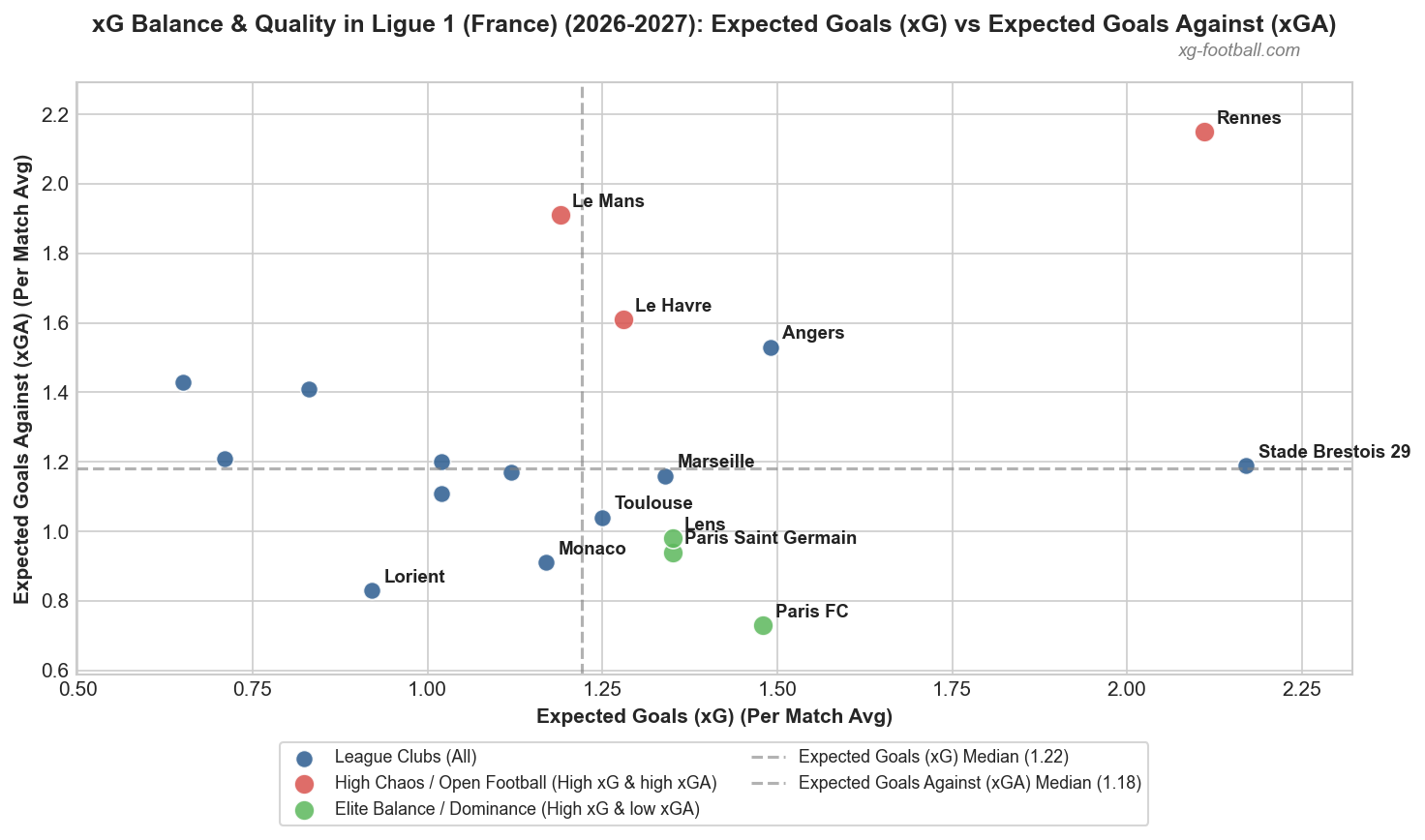
The opening eight matches of the 2026/27 Ligue 1 season reveal three distinct tactical profiles: teams that overwhelm opponents with attacking quality, sides that combine creation with defensive discipline, and clubs whose open games expose significant weaknesses at the back.
Across the 18-club sample, the league median stands at 1.22 expected goals (xG) and 1.18 expected goals against (xGA) per match. These benchmarks offer a useful reference point for assessing attacking output and defensive resilience.
Yet the most revealing statistic is the balance between the two. A team can generate plenty of chances without controlling matches, while another can build its success on restricting opponents to low-quality opportunities.
Brest Lead the Attacking Charge
Stade Brestois 29 stand out as the league’s most dangerous attacking side, averaging 2.17 xG per match. That figure is substantially above the league median and highlights their ability to generate high-quality scoring opportunities.
With an xGA of 1.19, Brest concede close to the league’s typical level. Their net xG balance of +0.98 is the strongest among the clubs analysed, suggesting a team whose attacking production gives it a significant underlying advantage.
Paris FC offer a different model of dominance. Their 1.48 xG is strong, but their outstanding figure is an xGA of just 0.73. With a net balance of +0.75, they combine productive attacking play with the most restrictive defence among the leading clubs.
Paris Saint-Germain and Lens also demonstrate impressive balance. Both average 1.35 xG, while their respective xGA figures of 0.94 and 0.98 indicate comparatively reliable defensive structures. Their net balances of +0.41 and +0.37 place them among the league’s strongest all-round performers.
Monaco, Toulouse and Marseille also maintain positive xG differentials, although their advantages are more modest. Lorient present an interesting variation: their attacking output is below the league median, but an xGA of just 0.83 gives them a small positive balance. Their profile suggests that defensive organisation may compensate for limited chance creation.
Rennes and the Problem of Open Football
At the opposite end of the tactical spectrum sits Rennes. Their 2.11 xG ranks among the league’s highest, but an xGA of 2.15 almost perfectly cancels out that attacking production.
The result is a net balance of −0.04. Rennes create enough opportunities to threaten almost any opponent, yet their defensive vulnerability allows opponents to respond in kind. Their matches have the statistical profile of open, high-event contests in which attacking ambition comes at a considerable defensive cost.
Le Mans face a more troubling problem. With 1.19 xG and 1.91 xGA, they create slightly less than the league median while conceding substantially more than the typical side. Their negative balance points to a need for greater defensive protection and more effective chance creation.
Le Havre show a similar, though less extreme, imbalance. Their 1.28 xG sits slightly above the league median, but an xGA of 1.61 suggests that their defensive structure is allowing opponents too many dangerous opportunities.
For these teams, improving results may depend less on increasing attacking volume and more on reducing the quality of chances conceded.
Elite Control Versus Attacking Chaos
The contrast between Paris FC and Rennes captures the central tactical divide in this dataset.
Paris FC combine above-median attacking output with exceptionally low xGA. Rennes generate far more attacking threat, but their defence gives opponents almost the same expected scoring output.
Brest occupy a third category: an attacking powerhouse whose exceptional chance creation produces the best net xG balance in the sample, despite a defence that is not quite as restrictive as Paris FC’s.
These profiles demonstrate why xG and xGA should be assessed together. High xG alone does not guarantee dominance, just as low xGA alone does not guarantee an effective attack. The strongest underlying teams are those that consistently create better opportunities than they allow.
Conclusion
The early-season numbers identify Brest as Ligue 1’s leading attacking force, Paris FC as one of its most balanced teams, and Rennes as a side whose attacking strengths are undermined by defensive instability. PSG and Lens also emerge as strong all-round contenders, while Le Mans and Le Havre have clear defensive concerns.
The key distinction is between creating danger and controlling it. Brest excel at the former, Paris FC combine both sides of the game, and Rennes illustrate the risks of attacking without sufficient defensive security.
These figures describe underlying performance rather than guaranteed results. Over an eight-match sample, finishing variance, goalkeeper performance and the quality of opposition can all influence the picture. Nevertheless, net xG provides a valuable early indicator of which teams are building sustainable advantages—and which may need tactical adjustments before their weaknesses become costly.