
Bundesliga 2026/27: Bayern’s Dominance, Leipzig’s Challenge and the League’s Defensive Chaos
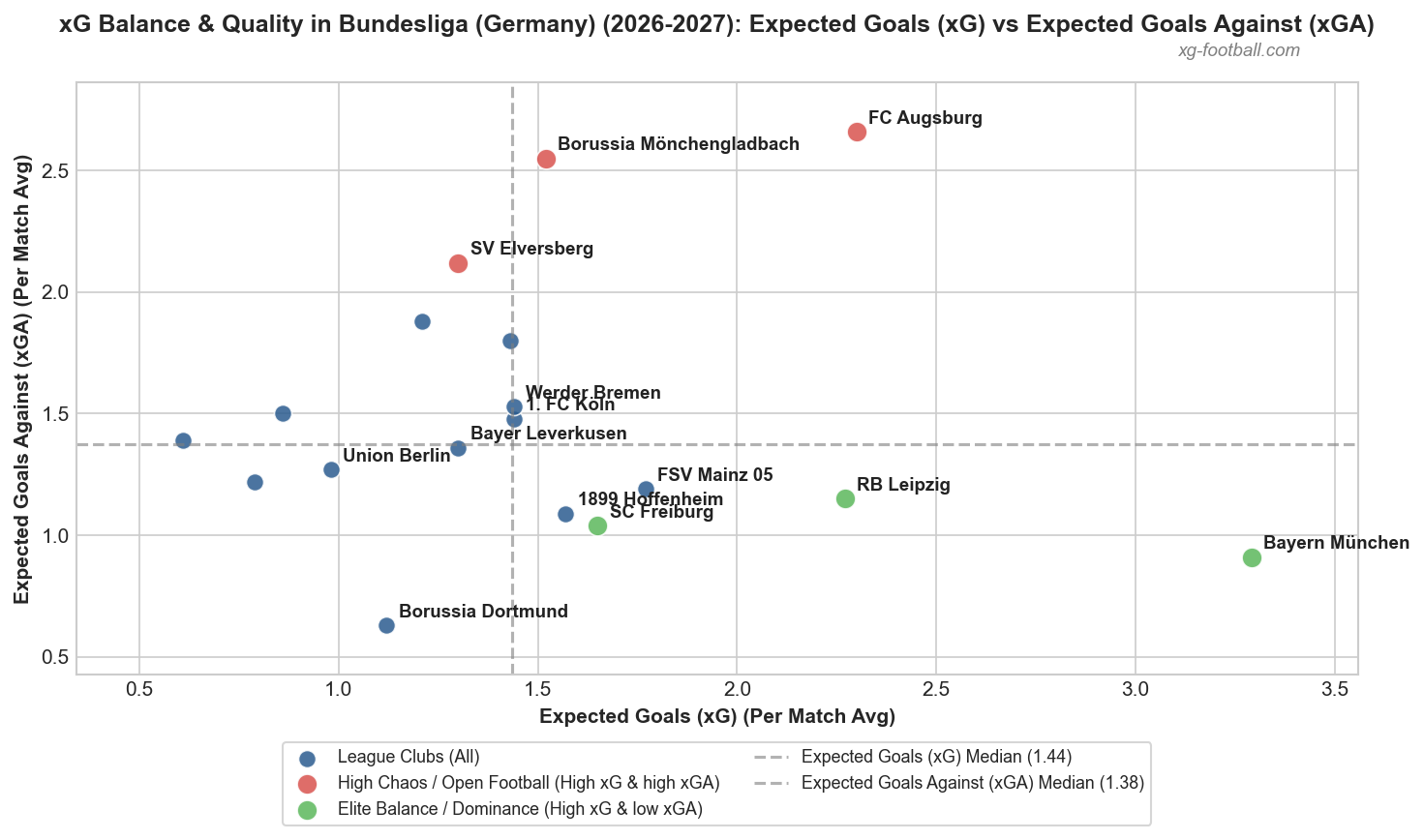
After seven matches, the underlying numbers paint a striking picture of the Bundesliga. Bayern München combine extraordinary attacking output with a disciplined defence, RB Leipzig emerge as convincing challengers, and several other clubs are caught in a cycle of creating chances while conceding far too many themselves.
Across the 18-club sample, the league median stands at 1.44 expected goals (xG) and 1.38 expected goals against (xGA) per match. These benchmarks help distinguish teams that consistently create dangerous opportunities from those whose defensive weaknesses undermine their attacking efforts.
Bayern Set the Standard
Bayern München are in a category of their own. Their 3.29 xG per match is more than double the league median, while an xGA of just 0.91 indicates that opponents generate relatively few high-quality chances in return.
Their net xG balance of +2.38 is the strongest in the sample by a substantial margin. Bayern’s profile combines overwhelming attacking pressure with defensive control—the foundation of a team capable of dominating matches at both ends of the pitch.
RB Leipzig are the closest challengers, recording 2.27 xG and 1.15 xGA for a balance of +1.12. Their attacking output is also well above the league average, while their defensive numbers suggest a more balanced approach than that of teams involved in frequent high-scoring exchanges.
SC Freiburg complete the leading trio, with 1.65 xG and 1.04 xGA. Their +0.61 balance reflects a different route to success: less attacking volume than Bayern or Leipzig, but a comparatively reliable defence.
Mainz, Dortmund and Hoffenheim: Different Routes to an Advantage
FSV Mainz 05 have produced 1.77 xG and conceded 1.19 xGA, resulting in a positive balance of +0.58. Their attacking output exceeds the league median, while their defensive record remains competitive.
Borussia Dortmund present an intriguing contrast. Their xGA of 0.63 is the lowest among the listed clubs, yet their xG stands at just 1.12. The resulting +0.49 balance suggests that defensive resilience is compensating for relatively limited chance creation.
For Dortmund, the next step would be to increase attacking productivity without sacrificing that defensive security.
Hoffenheim offer a more conventional balance, averaging 1.57 xG and 1.09 xGA. Their +0.48 differential places them among the teams with positive underlying performance at both ends of the pitch.
The Chaos Zone: Augsburg, Gladbach and Elversberg
Not every team is finding that balance.
FC Augsburg record 2.30 xG per match, an impressive attacking figure that ranks second in the supplied sample. However, their xGA reaches 2.66, meaning opponents are generating even greater expected scoring opportunities. Their net balance of −0.36 highlights the cost of defensive instability.
Borussia Mönchengladbach face an even more pronounced defensive problem. With 1.52 xG and 2.55 xGA, they concede far more danger than they create. Their attacking output is slightly above the league median, but that advantage is overwhelmed by the opportunities allowed at the other end.
SV Elversberg show a similar imbalance: 1.30 xG against 2.12 xGA. Their attack is below the league median, while their defensive vulnerability is considerable.
These teams share a common challenge: they need to reduce the quality and frequency of opposition chances. For Augsburg, that means preserving their attacking threat while improving defensive transitions. For Gladbach and Elversberg, defensive stability appears an even more pressing priority.
The Middle Ground: Small Margins, Big Questions
Several clubs sit close to an even balance. Köln record 1.44 xG and 1.48 xGA, while Bayer Leverkusen post 1.30 and 1.36 respectively. Werder Bremen produce 1.44 xG but concede 1.53.
These small negative differentials do not necessarily indicate major structural problems, but they show that these teams are not consistently gaining an advantage through chance quality alone.
Union Berlin face a different challenge. Their 0.98 xG and 1.27 xGA produce a balance of −0.29, suggesting that improving attacking output may be as important as maintaining their relatively competitive defensive numbers.
Conclusion: Control Is More Than Scoring Chances
The data reveal three broad profiles across the Bundesliga.
Bayern München combine exceptional attacking production with strong defensive control. RB Leipzig offer a similarly positive, though less extreme, balance, while Freiburg demonstrate how defensive reliability can underpin success without overwhelming attacking numbers.
At the other end, Augsburg, Borussia Mönchengladbach and Elversberg are conceding too many dangerous opportunities relative to what they create. Their challenge is not simply to attack more, but to make their overall game more sustainable.
The central lesson is that dominance depends on both sides of the ball. Bayern lead because their attacking threat is extraordinary and their defensive exposure remains limited. Dortmund show the value of defensive organisation, while the high-xGA teams illustrate how quickly attacking promise can be undermined by weaknesses without the ball.
These figures cover only seven matches per club, so they should be treated as early indicators rather than definitive verdicts. Nevertheless, net xG offers a useful lens through which to identify the teams building the strongest underlying advantages—and those with tactical imbalances to resolve.