
La Liga 2026/27: Barcelona’s Attacking Explosion, Real Madrid’s Balance, and the Defensive Chaos at the Other End
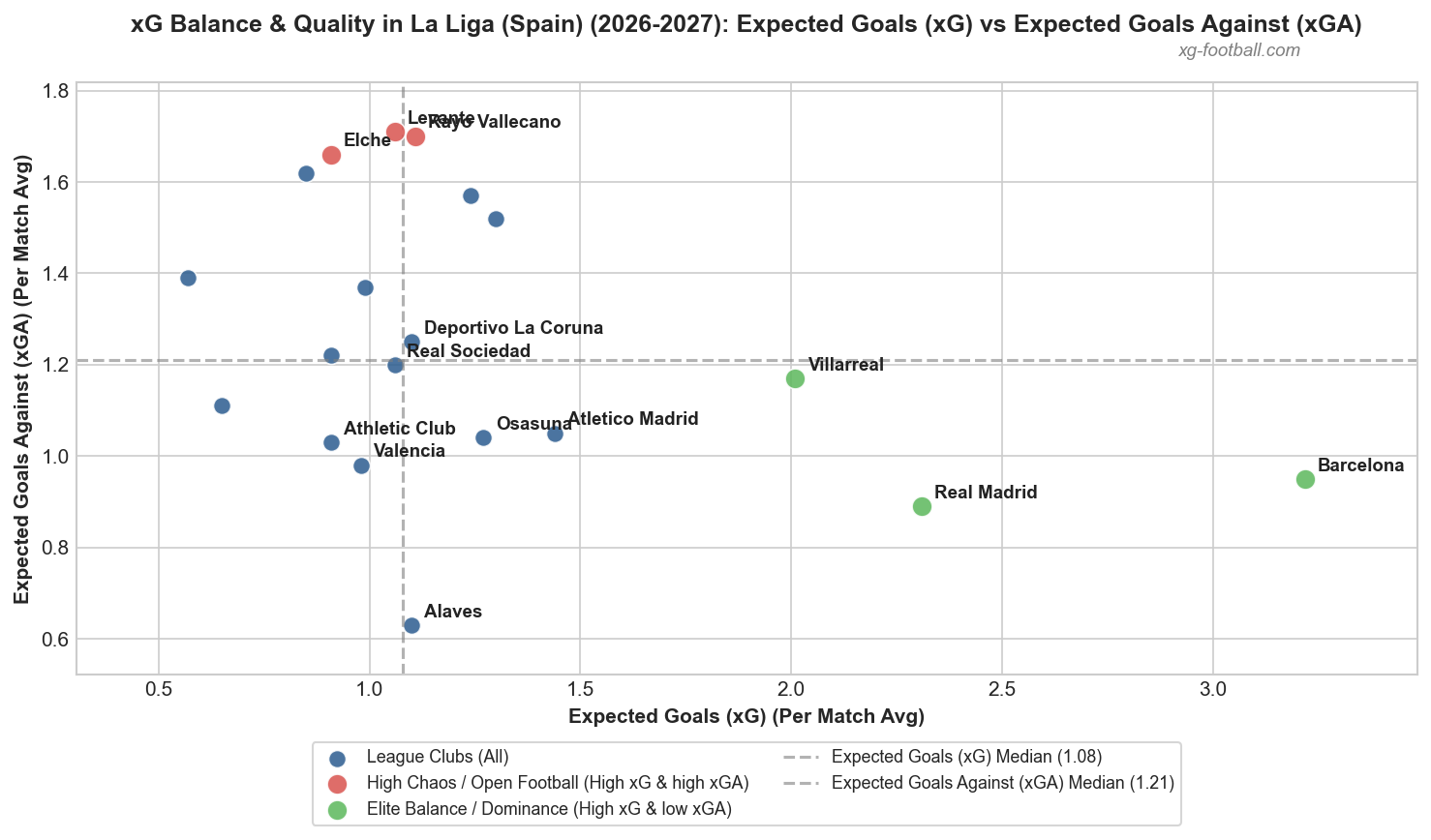
After the opening ten matches of the 2026/27 La Liga season, the expected-goals numbers reveal a striking divide. Barcelona are producing attacking numbers far beyond those of their rivals, Real Madrid combine a powerful forward threat with defensive discipline, and Villarreal have established themselves among the most balanced sides in the sample. Elsewhere, several teams are struggling to control the danger around their own penalty areas.
The league medians stand at 1.08 expected goals (xG) and 1.21 expected goals against (xGA). In this dataset, the typical team allows a slightly higher volume of expected goals than it creates. That makes defensive organisation particularly important: attacking promise alone does not guarantee a positive overall balance.
The key measure is net xG — the difference between expected goals created and expected goals conceded. A positive balance indicates that a team creates more expected scoring threat than it allows its opponents to generate. The larger the gap, the greater its statistical advantage in the two penalty areas.
1. The Leaders: Three Different Routes to Dominance
Barcelona: An attacking output in a league of its own
Barcelona stand out as the most extraordinary statistical profile in the sample. They average 3.22 xG per match, concede 0.95 xGA, and record a net balance of +2.27.
The attacking figure is remarkable. Against a league median of 1.08 xG, Barcelona are generating almost three times the expected goals of a typical team in the dataset. If the figures are calculated consistently, that points to an exceptional volume of high-quality scoring opportunities.
Just as importantly, Barcelona are not sacrificing defensive stability to achieve that attacking output. Their xGA of 0.95 is comfortably below the league median, suggesting that opponents are finding it difficult to create comparable danger at the other end.
This combination is what makes their profile so striking: Barcelona are not merely attacking relentlessly; they are also limiting the opportunities available to their rivals.
There is, however, an important caveat. An average of 3.22 xG is exceptionally high relative to the other teams listed. It is worth checking the underlying match data and calculation method before treating it as a reliable measure of sustained performance. If the figure is accurate and comparable, Barcelona's attacking production represents a remarkable start to the campaign.
Real Madrid: Power going forward, control without the ball
Real Madrid offer a slightly different model of dominance. Their xG stands at 2.31, while their xGA is just 0.89, producing a net balance of +1.42.
Madrid create more than two expected goals per game while keeping opponents below one. Their attacking output is lower than Barcelona's, but their defensive numbers are excellent.
An xGA of 0.89 suggests that Madrid are doing an effective job of limiting the quality or volume of opposition chances. Combined with their strong attacking production, it gives them a profile built on advantages at both ends of the pitch.
The distinction between the two giants is clear in the data. Barcelona lead through extraordinary attacking volume, while Madrid combine high production with a particularly restrictive defensive record.
Over a longer sample, this balance could prove valuable because it reduces dependence on attacking output alone. Even when Madrid do not create as much as Barcelona, their defensive performance helps preserve an overall advantage.
Villarreal: The third force in the numbers
Villarreal complete the leading trio with 2.01 xG and 1.17 xGA, giving them a net balance of +0.84.
Their attacking output is almost double the league median, making them one of the most productive sides in the sample. Their defensive figure is less impressive than those of Barcelona and Madrid, but it remains slightly below the league median of 1.21.
Villarreal's profile therefore sits between the two leading Spanish giants. They create a substantial amount of danger and maintain a positive defensive balance, although they allow more opportunities than Madrid and Barcelona.
The challenge is to turn that promising combination into sustained control. Reducing their xGA without compromising their attacking production would strengthen their position among the league's most effective teams.
2. Alaves: Defensive Discipline as a Competitive Weapon
Alaves deserve special attention because their numbers show that dominance does not always require an explosive attack.
Their xG is a modest 1.10, almost identical to the league median. Their xGA, however, is just 0.63 — the lowest figure among all listed clubs. That produces a positive net balance of +0.47.
Alaves are not overwhelming opponents through attacking volume. Instead, they appear to be restricting the quality or quantity of chances conceded, allowing a relatively ordinary attacking output to generate a positive overall balance.
This is a different route to success from Barcelona's attacking intensity or Villarreal's forward production. Alaves' numbers suggest that defensive discipline can compensate for a lack of attacking firepower.
The next step would be to increase their own chance creation without losing that defensive solidity. Improving the attacking side of the equation while preserving an xGA below one would make their profile even stronger.
3. Atletico Madrid and Osasuna: Solid, Positive Balances
Atletico Madrid record 1.44 xG and 1.05 xGA, giving them a net balance of +0.39. Their attacking output is above the league median, while their defensive figure is below it.
That combination suggests a reasonably balanced profile: Atletico create more expected goals than a typical team in the sample and limit their opponents to a lower-than-median level of threat.
Osasuna are less dominant but follow a similar pattern. With 1.27 xG and 1.04 xGA, they produce a positive balance of +0.23.
Neither side approaches the net figures recorded by Barcelona, Madrid, or Villarreal, but both remain on the positive side of the expected-goals equation. Their numbers point to teams that are generating a modest advantage rather than consistently overwhelming their opponents.
4. The Middle Ground: Valencia, Athletic Club, Real Sociedad and Deportivo
Valencia sit almost exactly at equilibrium, with 0.98 xG and 0.98 xGA. Their net balance is zero, meaning they create and concede an equal amount of expected-goals threat on average.
That does not mean every match is evenly contested. It simply indicates that, across the sample, Valencia have not established a measurable advantage in the difference between their own chances and those of their opponents.
Athletic Club have 0.91 xG and 1.03 xGA, producing a balance of −0.12 across nine matches. Their attacking output is below the league median, while their defensive figure is relatively respectable. Improving chance creation could be the most direct route towards a positive balance.
Real Sociedad record 1.06 xG and 1.20 xGA, leaving them at −0.14. Their figures are close to the league medians, but the balance currently tilts slightly towards their opponents.
Deportivo La Coruna have 1.10 xG and 1.25 xGA, producing a net balance of −0.15. Their attacking output is around the league benchmark, but they allow more expected goals than they create.
For these clubs, the differences are not as dramatic as those at the extremes of the dataset. Small improvements in attacking quality or defensive control could shift their profiles towards a positive balance.
5. High Chaos: Levante, Rayo Vallecano and Elche
At the other end of the spectrum are three teams whose defensive numbers raise concerns. Their high xGA suggests that opponents are generating too much expected scoring threat.
Levante average 1.06 xG but concede 1.71 xGA, giving them a net balance of −0.65. Their attacking output is close to the league median, yet their opponents create significantly more danger.
This imbalance makes defensive improvement a clear priority. Levante do not necessarily need to transform their attack overnight, but they must find ways to reduce the number and quality of chances conceded.
Rayo Vallecano show a similar pattern. Their 1.11 xG is almost exactly at the league median, but their xGA rises to 1.70. The resulting balance of −0.59 suggests that their attacking production is not enough to offset the threats they allow.
Elche face the most difficult combination of the three. They create just 0.91 xG and concede 1.66 xGA, leaving them with a net balance of −0.75.
Their problem exists at both ends of the pitch: limited attacking production and a relatively high volume of expected goals conceded. Improving only one side of that equation may not be sufficient to produce a major change in their overall balance.
These figures might be consistent with open matches, vulnerable transitions, or difficulties defending dangerous areas, but xG and xGA alone cannot identify the precise tactical cause. Nor do high expected-goals-against figures guarantee that actual matches will feature many goals.
The common priority is clear: restrict opponents' access to high-quality chances. Levante and Rayo must do so while preserving their existing attacking output, whereas Elche need improvements in both phases.
6. Elite Control Versus Open Chaos
The contrast between the strongest and weakest profiles highlights three different ways to build an advantage.
Barcelona: attacking dominance. Their 3.22 xG is the standout number in the dataset. If representative of their performances, it suggests an extraordinary ability to create scoring opportunities while maintaining a positive defensive balance.
Real Madrid: two-way control. Their 2.31 xG and 0.89 xGA combine high attacking production with a restrictive defensive record. They are not simply creating chances; they are also limiting their opponents.
Alaves: defensive control. Their 0.63 xGA is the lowest in the sample. They show how a team can maintain a positive balance through defensive organisation even without a high attacking output.
Villarreal provide another variation: their attacking production is strong, while their xGA remains close to the league median. By contrast, Levante, Rayo Vallecano, and Elche are allowing substantially more expected goals than they create.
The gap between these profiles is more informative than attacking numbers alone. A team that creates 1.5 xG while conceding 0.7 may have a stronger overall expected-goals balance than one that creates 1.8 but concedes 1.6.
Conclusion: Barcelona Set the Pace, Madrid Balance the Equation
The data from this ten-match sample point to three distinct models of performance in La Liga.
Barcelona stand out for their extraordinary attacking output and a net balance of +2.27. Real Madrid combine strong chance creation with an xGA below 0.9, while Villarreal produce a positive balance through a potent attack and a reasonably controlled defence.
Alaves demonstrate the value of defensive discipline, and Atletico Madrid and Osasuna also maintain positive balances. Valencia sit at equilibrium, while Athletic Club, Real Sociedad, and Deportivo show modest negative differentials.
Levante, Rayo Vallecano, and Elche face a different challenge: their opponents are creating too much expected-goals threat, and their own attacking production is not sufficient to compensate.
The sample is still relatively small — ten matches for most teams and nine for Athletic Club — so these patterns should be treated as early indicators rather than definitive season-long verdicts. Expected goals measure the quality of chances, not actual goals, and unusual values such as Barcelona's 3.22 xG warrant checking against the underlying data.
The central lesson is that dominance requires both creation and control. Barcelona lead through attacking volume, Real Madrid combine threat with defensive restraint, and Alaves show how limiting opponents can be just as valuable as creating chances.