
Serie A 2026/27: Inter Set the Standard as Roma Surge and Juventus Build a Defensive Fortress
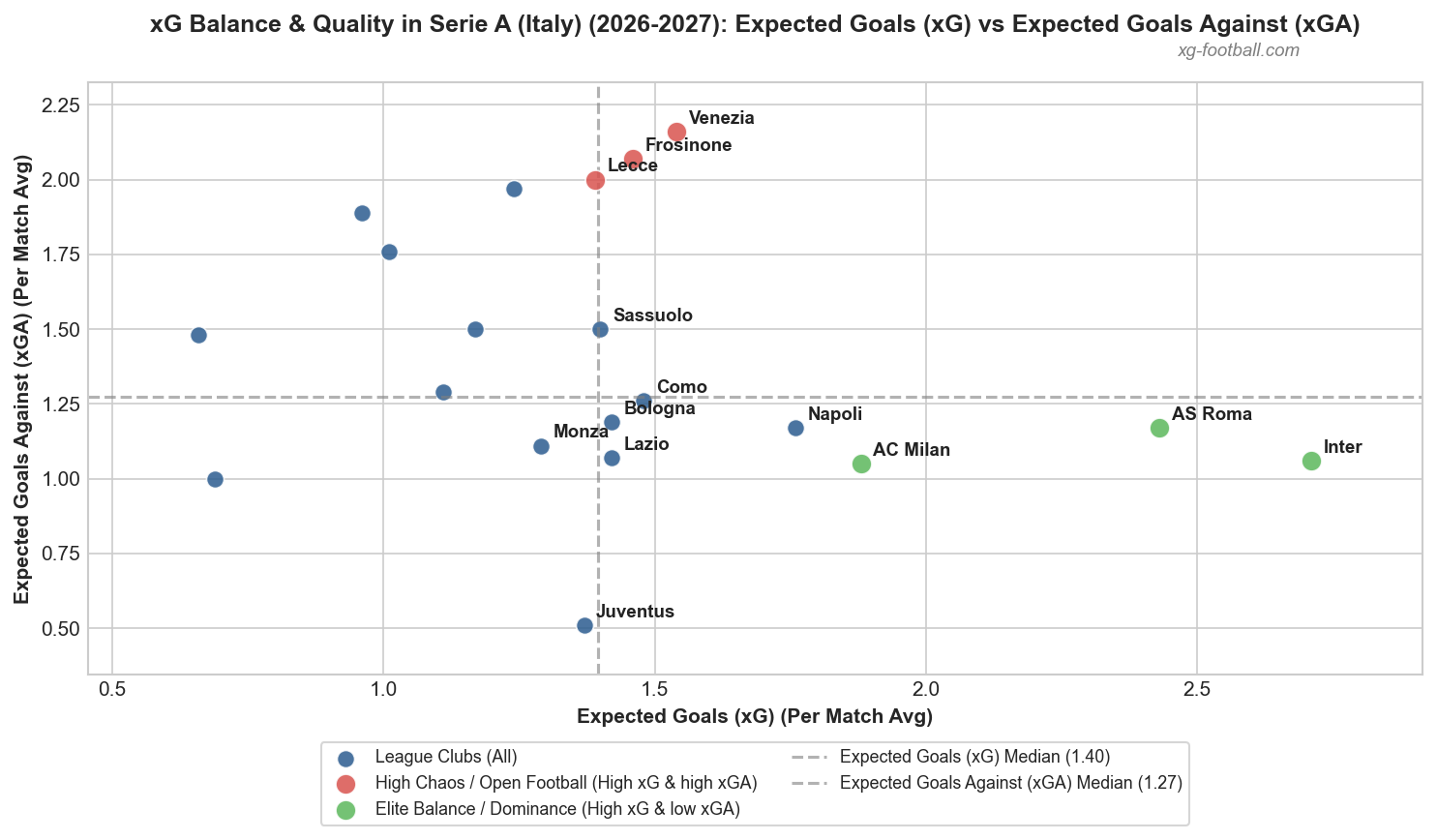
Nine matches into the season, Serie A is already revealing a fascinating divide between teams that control games through attacking pressure, sides that rely on defensive discipline, and clubs whose matches threaten to spiral into end-to-end chaos. The expected-goals data paints a picture of a league where dominance is not simply about scoring more, but about consistently creating better chances than opponents.
The league median stands at 1.40 expected goals (xG) and 1.27 expected goals against (xGA) per match. These figures provide a useful benchmark: teams creating well above 1.40 xG are generating more attacking threat than the typical Serie A side, while those keeping xGA below 1.27 are limiting opponents more effectively than average.
The strongest teams are those that combine both qualities. A high xG can indicate attacking ambition, but if it comes alongside a similarly high xGA, the team may be trading chances rather than controlling the contest. The most convincing profiles belong to clubs that create substantial danger while keeping the opposition relatively quiet.
Inter: The league’s most complete attacking force
Inter lead the entire sample with an extraordinary 2.71 xG per match, comfortably ahead of Roma in second place at 2.43. That is 1.31 expected goals above the league median — a substantial gap that suggests Inter are generating dangerous opportunities at a rate few rivals can match.
Crucially, their defensive numbers support the attacking story. Inter concede just 1.06 xGA per match, below the league median of 1.27. Their net expected-goals balance of +1.65 is the best among the listed clubs.
This combination separates Inter from teams that attack aggressively but leave themselves exposed. Their profile suggests a side capable of imposing its own rhythm while limiting the quality of the opposition’s opportunities. Rather than relying solely on finishing, Inter appear to be building a structural advantage at both ends of the pitch.
If these numbers hold over a longer stretch, Inter will have the underlying profile of a genuine title contender. Their challenge is to sustain that attacking output against stronger defensive opponents and ensure that their impressive chance creation translates into results.
Roma: An attacking challenger with serious momentum
Roma are the closest side to Inter in attacking production, averaging 2.43 xG per match. Their net balance of +1.26 is also the second-best in the sample, confirming that their attacking threat is not being cancelled out by defensive vulnerability.
Roma’s xGA of 1.17 sits below the league median, giving them a positive balance between creation and prevention. They may not be as defensively restrictive as Juventus or as balanced as Inter, but their combination of high attacking output and respectable defensive numbers is formidable.
The distinction between Roma and Inter is one of degree. Roma are generating enough chances to dominate opponents, yet Inter currently have the advantage in both attacking production and defensive control. Roma’s numbers nevertheless suggest a team capable of competing at the top if their underlying performance remains consistent.
Juventus: A defensive fortress with a different route to dominance
Juventus present one of the most striking statistical contrasts in the league. Their attacking output is 1.37 xG, slightly below the 1.40 median, but their xGA is an exceptional 0.51 per match.
That is the lowest defensive figure among the teams provided, and it puts Juventus in a distinctive position. Their net balance of +0.86 is the third-best in the sample, despite their relatively modest attacking production.
The numbers point towards a team whose advantage comes from restricting opponents rather than overwhelming them with chances. Juventus do not need to lead the league in xG if they can consistently prevent rivals from generating meaningful opportunities.
However, the sample is only nine matches. An xGA as low as 0.51 may reflect outstanding defensive organisation, the opponents faced so far, or some short-term statistical variation. More matches will reveal whether Juventus can maintain such a restrictive defensive level.
Even with that caveat, their profile stands out. While Inter and Roma appear to impose themselves through attacking force, Juventus are demonstrating how defensive control can produce a similarly strong underlying balance.
AC Milan: The strongest all-round challenger
AC Milan offer perhaps the most straightforward example of attacking and defensive balance after Inter and Roma. They average 1.88 xG and 1.05 xGA, producing a net balance of +0.83.
Their attacking output is comfortably above the league median, while their defensive figure is significantly below it. Milan therefore combine above-average chance creation with above-average prevention — a profile that can support consistency over a long campaign.
Milan’s net balance is only marginally below Juventus’, but the two teams arrive there through different routes. Juventus are exceptionally restrictive at the back; Milan generate considerably more attacking threat while still keeping their xGA low.
That balance gives Milan a strong foundation. They are not dependent on one extreme statistical strength, and their combination of attacking production and defensive restraint makes them one of the most convincing teams in the sample.
Napoli: Strong production, but a smaller margin of control
Napoli average 1.76 xG and 1.17 xGA, giving them a net balance of +0.59. Both figures compare favourably with the league medians: their attacking output is above average, while the expected danger conceded is below average.
The gap between Napoli and the leading trio is nevertheless noticeable. Their numbers suggest a strong side with a positive underlying balance, but not yet one exerting the same statistical pressure as Inter or Roma.
Napoli’s ability to maintain that advantage will depend on whether their attacking production remains consistent and whether they can further reduce the quality of opportunities conceded. They have a solid platform, though the current figures leave them a step behind the most dominant profiles.
The middle ground: Lazio, Bologna and Como
Lazio, Bologna and Como occupy a more finely balanced tier.
Lazio record 1.42 xG and 1.07 xGA, giving them a +0.35 balance. Their attacking output is only slightly above the league median, but their defensive numbers are encouraging. This suggests a team that can create enough to compete while keeping opponents relatively contained.
Bologna have almost identical attacking production at 1.42 xG, but concede 1.19 xGA. Their net balance of +0.23 remains positive, although their defensive advantage is smaller than Lazio’s.
Como average 1.48 xG and 1.26 xGA. Their attacking numbers are promising, but their xGA sits almost exactly at the league median. They create more than the typical side, yet their defensive performance offers little additional margin for error.
Monza follow a different path. With 1.29 xG and 1.11 xGA, they generate slightly less than the league median but compensate with more controlled defensive numbers. Their +0.18 balance suggests a narrow advantage rather than outright dominance.
Sassuolo, meanwhile, sit at 1.40 xG — exactly the league median — while conceding 1.50 xGA. Their net balance of -0.10 indicates that average attacking production is not enough to offset their defensive exposure. Improving their ability to limit opponents could be more important than simply increasing attacking volume.
The chaos teams: Venezia, Frosinone and Lecce
At the opposite end of the defensive spectrum are Venezia, Frosinone and Lecce. Their xGA figures are among the most alarming in the sample:
- Venezia: 1.54 xG, 2.16 xGA
- Frosinone: 1.46 xG, 2.07 xGA
- Lecce: 1.39 xG, 2.00 xGA
All three concede expected goals at a rate far above the league median. Their opponents are not merely getting occasional opportunities; the figures suggest a recurring ability to generate dangerous chances.
Yet these teams are not completely ineffective in attack. Venezia’s 1.54 xG is above the league median, while Frosinone’s 1.46 is also respectable. Lecce, at 1.39, are almost exactly at the benchmark.
That creates the classic profile of an open, high-risk team: enough attacking activity to threaten opponents, but insufficient defensive control to protect the results of its own work.
For Venezia, the problem is particularly stark. Creating 1.54 xG per match can provide a foundation for competitive football, but conceding 2.16 means the opposition is generating far more expected danger. Unless Venezia can reduce that gap, they may find themselves needing to score repeatedly just to stay in matches.
Frosinone face a similar imbalance. Their attacking production is not poor, but an xGA of 2.07 suggests that their defensive structure is allowing too many high-quality opportunities. Lecce’s situation is comparable: their attacking output is close to average, yet their defensive numbers are substantially worse.
High xGA does not automatically mean that individual defenders are at fault. The source may lie in turnovers, ineffective pressing, poor protection during transitions, gaps between the lines or an inability to defend wide areas. Additional metrics would be needed to identify the precise cause.
What the numbers do show is that these teams are struggling to control the danger they allow. Their matches may be entertaining, but open football is not necessarily effective football.
Elite control versus open chaos
The contrast between Inter, Roma and Milan on one side and Venezia, Frosinone and Lecce on the other captures the central tactical divide in this dataset.
The elite group creates more expected goals than the league median while conceding less. Inter lead with 2.71 xG and 1.06 xGA; Roma follow with 2.43 and 1.17; Milan record 1.88 and 1.05. Their advantages are built on positive balances between attacking production and defensive prevention.
The chaos group, by contrast, cannot reliably prevent opponents from generating danger. Venezia and Frosinone have respectable attacking figures, but their defensive exposure is so high that it undermines their overall profile.
Juventus offer a third model: exceptional defensive control with only average attacking production. Their 0.51 xGA is an outlier, and if it proves sustainable, it could make them highly competitive without requiring them to match the attacking output of Inter or Roma.
These are different ways to build a successful team, but they share one principle: the objective is not simply to create chances — it is to create more and better chances than the opponent.
Final verdict: The numbers favour control over chaos
After nine matches, Inter have the strongest overall statistical profile in the sample. Their attacking output is unmatched, and their defensive numbers remain comfortably better than the league median. Roma are the closest attacking challenger, while Milan combine strong chance creation with reliable prevention. Juventus deserve particular attention for their extraordinary defensive figures.
At the other end, Venezia, Frosinone and Lecce have a clear problem to solve. Their attacking numbers offer some encouragement, but their high xGA suggests that opponents are finding dangerous opportunities too easily.
These figures should not be treated as final verdicts. Expected goals measure the quality of chances created and conceded, not goals themselves. Finishing, goalkeeping, opponent strength and the randomness of individual matches can all influence results, especially over a nine-match sample.
Still, the early picture is compelling: Serie A’s most convincing teams are not merely attacking well or defending well. They are building a repeatable advantage across both phases of the game. The teams that can sustain that balance are likely to have the strongest foundation for the months ahead — while those caught in the cycle of open, high-xGA football may discover that excitement comes at a heavy cost.