
Europe’s xG Kings: Bayern and Barcelona Set the Pace as Inter Perfects the Art of Control
Ninety-six clubs, five major leagues, and a growing divide between teams that dictate matches and those that survive them. The early expected-goals numbers reveal Europe’s most dominant sides — and expose the defensive weaknesses threatening to undermine several ambitious teams.
The 2026–27 season is still in its early stages, but the underlying numbers already tell a compelling story. Bayern München and Barcelona are producing attacking figures that stand apart from the rest of the field, Inter are combining devastating creativity with defensive discipline, and Real Madrid are showing how a team can dominate without needing the highest attacking output in the competition.
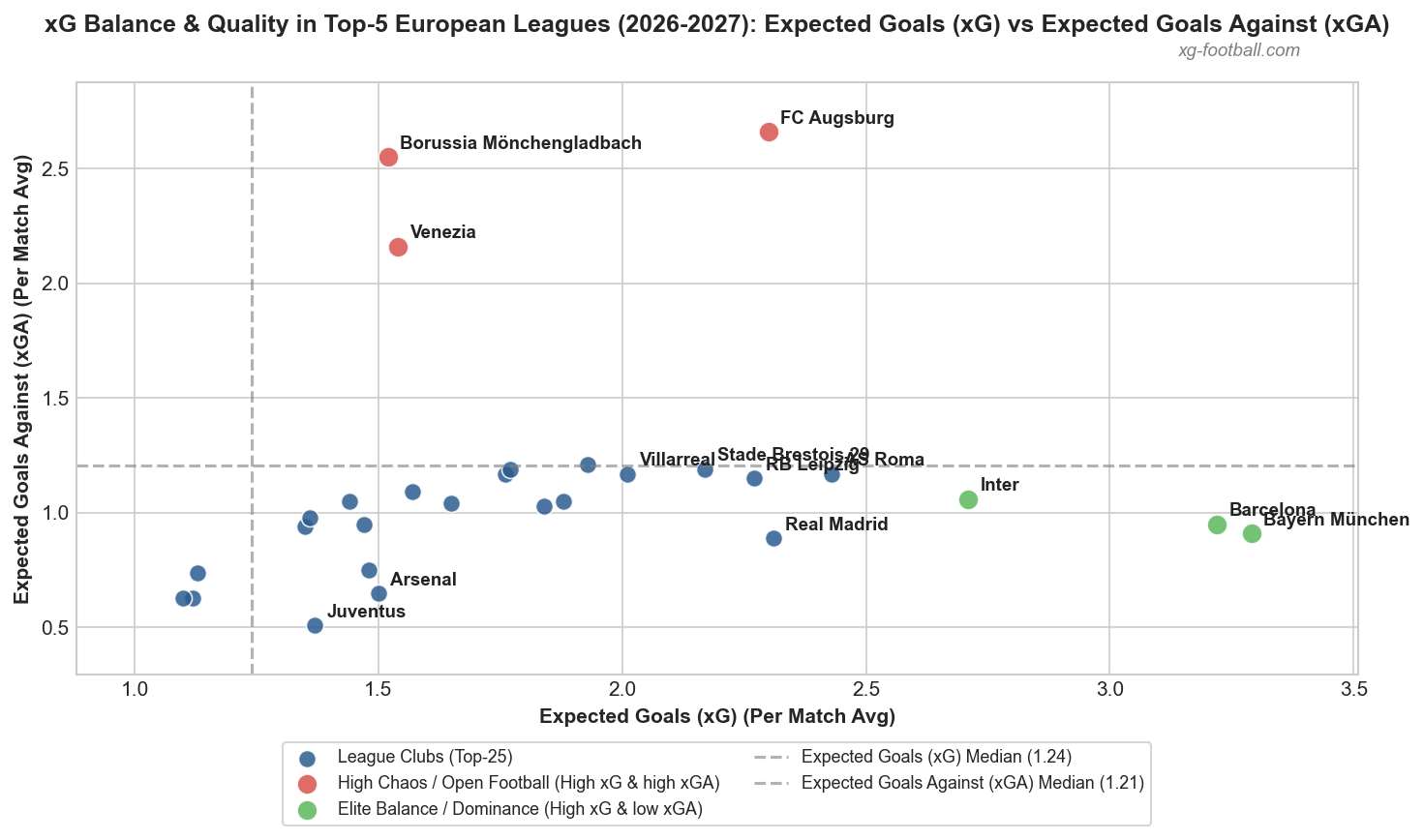
Across the 96 clubs analysed, the league-wide median stands at 1.24 expected goals (xG) and 1.20 expected goals against (xGA) per match. These figures provide a baseline for assessing performance. Teams above 1.24 xG are creating more attacking threat than the typical club in the sample, while those below 1.20 xGA are restricting opponents more effectively than average.
The most important distinction, however, lies in the relationship between the two. A team can create plenty of chances and still struggle to control matches if it allows opponents to generate similar or greater danger. True statistical dominance comes from building a consistent advantage at both ends of the pitch.
Bayern München and Barcelona: Attacking football at another level
Bayern München sit at the summit with 3.29 xG and 0.91 xGA per match, producing a remarkable net balance of +2.38. Barcelona are almost level, recording 3.22 xG, 0.95 xGA and a net balance of +2.27.
These are extraordinary numbers. Both clubs are generating more than two expected goals above the typical attacking baseline while keeping their opponents below one expected goal per match.
Bayern’s attacking output is the highest in the entire sample. At 3.29 xG, they are creating a level of expected scoring threat that would be exceptional even for an elite European side. Yet their defensive figure is equally revealing: 0.91 xGA suggests that their attacking aggression has not translated into excessive exposure at the other end.
That combination is what makes Bayern’s profile so compelling. They are not simply overwhelming opponents through attacking volume; they are also limiting the quality of the opportunities opponents can create.
Barcelona offer a remarkably similar picture. Their 3.22 xG confirms a formidable attacking engine, while 0.95 xGA points towards an effective defensive structure. The gap between the two sides is minimal, and the available data do not justify declaring one categorically superior in overall performance.
There is, however, an important qualification. Bayern’s figures come from seven matches, compared with Barcelona’s ten. Such extreme numbers should be reassessed as the sample grows and the strength of opponents faced becomes clearer.
For now, though, these two clubs occupy a category of their own. Their combination of attacking production and defensive restraint sets the benchmark for the rest of Europe.
Inter: The blueprint for balanced dominance
If Bayern and Barcelona represent attacking pressure at maximum intensity, Inter offer one of the clearest examples of complete tactical balance.
The Italian side average 2.71 xG and 1.06 xGA, giving them a net balance of +1.65. That places them third in the overall ranking and makes them one of the most convincing all-round performers in the sample.
Inter’s attacking production is comfortably above the European median, while their defensive numbers remain better than average. They create significant danger without allowing opponents to respond with a comparable volume of quality chances.
This is the difference between simply attacking well and controlling a match. Possession, shots and forward movement can all look impressive, but they become less meaningful if the opposition consistently finds dangerous spaces in return. Inter’s numbers suggest a team capable of sustaining pressure while maintaining a reasonable defensive balance.
Their net figure is well below Bayern’s and Barcelona’s, but that does not diminish the strength of their profile. Rather, it highlights how exceptional the two leaders have been. Inter remain a benchmark for teams seeking to combine attacking ambition with defensive reliability.
Real Madrid: A defensive foundation behind elite attacking output
Real Madrid rank fourth with 2.31 xG, 0.89 xGA and a net balance of +1.42 across ten matches.
Their attacking output is substantially above the median, but the most striking element is their defensive performance. At 0.89 xGA, Madrid have one of the lowest figures in the entire sample — lower even than those of Bayern, Barcelona and Inter.
This suggests a team that can create significant attacking danger while keeping opponents unusually quiet. Madrid do not need to match Bayern’s attacking volume to establish a strong statistical advantage; their ability to restrict opposition chances gives them another route to control.
Their profile is particularly impressive because it does not depend on one extreme strength. They combine high attacking production with outstanding defensive numbers, creating a substantial margin between the danger they generate and the danger they concede.
The figures do not, by themselves, explain how Madrid achieve this balance. More detailed data on pressing, shot locations, possession losses and defensive transitions would be needed to identify the precise mechanisms. Nevertheless, the underlying advantage is clear.
Roma and RB Leipzig: Serious attacking threats with controlled risk
AS Roma rank fifth with 2.43 xG, 1.17 xGA and a net balance of +1.26. Their attacking production is second only to a small group of Europe’s most prolific sides, while their defensive figure sits slightly below the sample median.
Roma’s profile is built primarily on creative strength. They generate substantial attacking threat without allowing their defensive numbers to deteriorate significantly. Although their xGA is higher than Inter’s or Real Madrid’s, their attacking output helps maintain a strong overall balance.
RB Leipzig show a similar pattern. With 2.27 xG and 1.15 xGA, they record a net balance of +1.12. Their attacking numbers are well above the European baseline, and their defensive output remains relatively controlled.
Both clubs have the foundations of high-level performers. They are not producing the extraordinary margins of Bayern or Barcelona, but they are building an advantage through strong attacking play supported by reasonably reliable defence.
As with the other leading teams, sample size matters. Leipzig have played seven matches and Roma nine, so their current positions should be treated as promising early indicators rather than definitive season-long verdicts.
Brest: A French contender making its numbers count
Stade Brestois 29 are one of the more intriguing names in the top ten. They average 2.17 xG and 1.19 xGA, giving them a net balance of +0.98.
Their attacking production is substantially above the median, while their xGA sits just below the European benchmark. That is an attractive combination: Brest are generating significant danger without allowing opponents to create more than the typical side in the sample.
These numbers do not establish that Brest possess the same squad depth or individual quality as Europe’s biggest clubs. Expected goals measure the quality of chances, not every dimension of team strength.
But the statistical signal is meaningful. Across their eight matches, Brest have produced a positive underlying balance that compares favourably with many more prominent teams. Maintaining that advantage against a broader range of opponents would strengthen the case that their early performance reflects a sustainable tactical identity.
Juventus and Arsenal: Defensive control as a competitive weapon
Juventus and Arsenal demonstrate a different route to a positive xG balance. Neither has the attacking output of Bayern, Barcelona or Inter, but both have been exceptional at limiting opponents.
Juventus record 1.37 xG and just 0.51 xGA per match. That is the lowest defensive figure among all 96 clubs in the sample, producing a net balance of +0.86.
Arsenal average 1.50 xG and 0.65 xGA, giving them a net balance of +0.85. Their attacking output is slightly higher than Juventus’, while their defensive numbers remain remarkably restrictive.
The underlying message is clear: dominance does not always require an overwhelming attacking display. A team that consistently prevents opponents from creating high-quality opportunities can build a substantial advantage even when its own xG is closer to the league median.
Juventus are the more extreme example. Their attacking output is only slightly below the median, yet their defensive figure creates a strongly positive balance. Arsenal offer a similar profile with a little more attacking production.
Both teams deserve attention, but their defensive figures also require caution. Juventus have played nine matches and Arsenal eight. Such low xGA values can reflect excellent organisation, the quality of opponents faced and short-term variation. The coming months will reveal whether they can sustain this level.
Villarreal: Consistency without extremes
Villarreal complete the top ten with 2.01 xG and 1.17 xGA, producing a net balance of +0.84.
Their attacking production is well above the European median, while their defensive figure remains below it. Unlike Bayern and Barcelona, Villarreal are not posting extraordinary numbers in either direction. Their strength lies in combining two positive indicators rather than relying on a single statistical outlier.
This makes their profile especially interesting over a longer campaign. Teams do not always need spectacular peaks to perform consistently; a strong attacking baseline and a defence that avoids conceding too many high-quality chances can provide a solid foundation.
Villarreal’s current figures suggest precisely that kind of balanced advantage.
The chaos clubs: When attacking ambition becomes defensive exposure
At the opposite end of the spectrum are teams whose attacking production is respectable but whose defensive numbers threaten to undermine everything they create.
FC Augsburg record 2.30 xG and 2.66 xGA, giving them a net balance of −0.36. Their attacking figure would be impressive in isolation, but opponents are generating even more expected danger.
This is the defining feature of open, high-risk football. Augsburg can create enough opportunities to trouble almost any opponent, yet their defensive structure appears to allow too many dangerous responses. Their attacking work is not translating into overall control.
Borussia Mönchengladbach present an even more concerning balance. They average 1.52 xG but concede 2.55 xGA, leaving them with a net figure of −1.03.
Their attacking production is above the European median, but the defensive deficit is enormous. At this rate, even a reasonably productive attack may struggle to compensate for the quality of chances allowed at the other end.
Venezia complete the group with 1.54 xG and 2.16 xGA, a net balance of −0.62. Like Augsburg and Mönchengladbach, they create enough to remain a threat, but their defensive exposure is far too high relative to the danger they generate.
These three teams illustrate why entertaining football and effective football are not always the same thing. Matches with repeated attacks at both ends can be exciting, but from a performance perspective, the critical question is who creates the better chances — and how often.
For these clubs, the solution may not be to attack more. It may be to improve the structure behind their attacks, protect space after possession losses, reduce dangerous turnovers and prevent opponents from reaching high-quality shooting positions.
High xGA does not automatically mean that individual defenders are at fault. Weak pressing, exposed transitions, gaps between the lines or problems defending wide areas can all contribute. The data identify the imbalance, even if they do not independently explain its tactical cause.
Elite control versus open chaos
The contrast between the leading clubs and the high-xGA group reveals three broad models of performance.
First, overwhelming attacking dominance. Bayern and Barcelona create more than 3.2 xG per match while keeping xGA below one. Their profiles combine exceptional attacking production with effective limitation of opposition danger.
Second, balanced dominance. Inter, Real Madrid, Roma and RB Leipzig generate well above-average attacking threat while maintaining relatively controlled defensive numbers. Their advantage comes from performing strongly across both phases rather than relying on one extreme characteristic.
Third, defensive control. Juventus and Arsenal show that restricting opponents can be a powerful route to a positive balance. Their attacking figures are more modest, but their exceptionally low xGA creates a substantial statistical advantage.
Augsburg, Borussia Mönchengladbach and Venezia sit on the other side of the divide. Their numbers suggest that defensive exposure is eroding the value of their attacking output.
The distinction matters because xG and xGA are not direct predictions of final scores. They estimate the quality of chances created and conceded, rather than the goals that will actually be scored. Finishing, goalkeeping, opponent strength and short-term variation can all affect outcomes, particularly early in the season.
Final verdict: The best teams control both ends of the pitch
The early numbers identify Bayern München as the leading club by net expected-goals balance, with Barcelona close behind. Both combine extraordinary attacking output with xGA below one per match.
Inter stand out for their all-round balance, Real Madrid for their combination of attacking threat and defensive restriction, and Roma for their creative production. Juventus and Arsenal demonstrate that exceptional defence can be just as important as a prolific attack.
At the other end, Augsburg and Borussia Mönchengladbach illustrate the risks of a high-chaos approach. Their attacking numbers are not inherently poor, but their opponents are creating too much danger for that attacking activity to translate into a positive balance.
The season is still young, and the most extreme figures will need to be tested over a longer run of matches. Nevertheless, the broad pattern is already clear: elite football is not simply about creating more chances. It is about consistently creating better opportunities than the opposition while preventing them from doing the same.
That is the advantage Bayern and Barcelona are currently establishing — and the standard the rest of Europe must chase.