
Bundesliga 2026–27: Franck Honorat Leads the Creative Race as Raum Searches for End Product
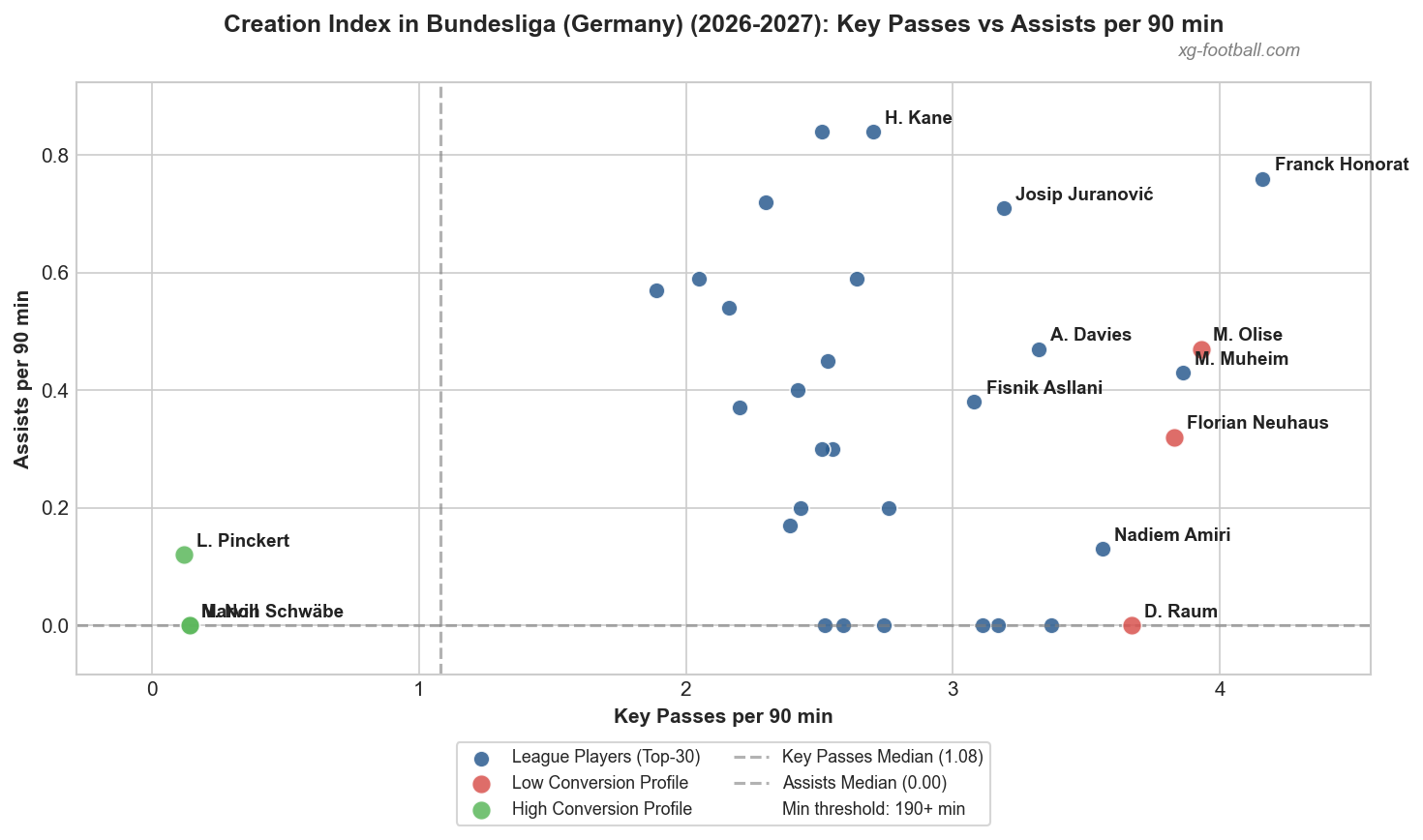
The Bundesliga’s early creative rankings reveal a compelling mix of established stars, emerging contributors and players whose influence is not yet reflected in their assist totals. Franck Honorat leads the way for Borussia Mönchengladbach, Bayern Munich have several creators near the top, and David Raum stands out as one of the league’s most prolific providers of shooting opportunities without a single assist to show for them.
The dataset covers 234 players who have played at least 190 minutes. The league median is 1.08 key passes and 0.0 assists. In practical terms, the typical player in this sample produces around one key pass per comparable playing period, while the median assist figure remains at zero.
That contrast matters. A key pass creates an opportunity for a shot; an assist records a pass that directly precedes a goal. The first measures creative involvement, while the second depends on the final action being converted. A player can therefore influence attacking play consistently without accumulating assists at the same rate.
Franck Honorat sets the pace
Franck Honorat of Borussia Mönchengladbach tops the rankings with 4.16 key passes and 0.76 assists, producing a combined score of 4.92 in the supplied data.
His key-pass figure is almost four times the league median, making him the standout creator in this sample. Honorat is repeatedly involved in the actions that give teammates opportunities to shoot, and his assist figure suggests that at least some of this creative work is already translating into goals.
There is, however, an important qualification: Honorat has played only 238 minutes. His rate is outstanding, but the sample remains small. A few additional appearances could significantly change his position in the rankings.
Even with that caveat, his presence at the top is a major talking point. Borussia Mönchengladbach also have Florian Neuhaus among the leading creators, suggesting that the team has more than one potential source of attacking invention.
Olise and Muheim: close behind the leader
Michael Olise of Bayern Munich ranks second with 3.93 key passes and 0.47 assists in 573 minutes. His creative output is close to Honorat’s, but his larger sample gives the numbers a more substantial foundation.
Olise appears to be a consistent source of opportunities in Bayern’s attacking structure. His key-pass rate is well above the league median, and his assist tally shows that his contribution is not limited to creating shots that go unfinished. The next challenge is to maintain that balance as the season progresses.
M. Muheim of Hamburger SV is another notable name. With 3.86 key passes and 0.43 assists in 210 minutes, he sits just behind Olise in the combined ranking.
Muheim’s numbers are especially eye-catching because of his limited playing time. He has already demonstrated a high rate of creative involvement, but his position should be viewed as provisional until he accumulates a larger sample. If he maintains this level, he could become one of Hamburger SV’s most important attacking contributors.
Florian Neuhaus gives Gladbach a second creative outlet
Florian Neuhaus has recorded 3.83 key passes and 0.32 assists in 282 minutes. His creative volume places him among the Bundesliga’s leading playmakers, but his assist return is lower than those of several players around him.
That gap makes Neuhaus one of the most interesting players in the dataset. He is consistently involved in preparing shots, yet the final statistical reward remains relatively modest.
This does not automatically mean his teammates are wasting chances. Key passes can lead to shots from difficult positions, and some opportunities may be blocked or saved. Expected assists (xA) and shot-quality data would help determine whether Neuhaus is genuinely being let down by poor finishing.
For Gladbach, the encouraging point is that both Honorat and Neuhaus feature prominently. Having multiple players capable of creating opportunities can make an attack less predictable and reduce its dependence on one individual.
Juranović and Davies: creativity from different positions
Josip Juranović of Union Berlin has produced 3.19 key passes and 0.71 assists in 254 minutes. His assist figure is particularly strong relative to his creative volume, suggesting that a meaningful share of his involvement has already resulted in goals.
Juranović’s numbers highlight a different profile from Honorat’s. Rather than leading the ranking through sheer volume, he combines a high rate of key passes with a substantial assist return. His limited minutes remain a caveat, but the early signs are promising.
Alphonso Davies of Bayern Munich has recorded 3.32 key passes and 0.47 assists in 379 minutes. His presence among the top creators illustrates how attacking influence can come from wide and deeper positions, not just from conventional playmakers.
Davies’ figures suggest that his involvement extends beyond carrying the ball forward. He is also helping teammates reach shooting positions, adding another dimension to Bayern’s attacking options.
Amiri and Raum: high volume, limited reward
Nadiem Amiri of Mainz 05 has registered 3.56 key passes and 0.13 assists across 683 minutes. His playing time is among the highest in the top ten, making the contrast between creative activity and direct output especially notable.
Amiri has had a substantial opportunity to demonstrate his creative influence, and his key-pass rate remains well above the league median. Yet his assist return is modest.
That discrepancy deserves attention, but it should not be interpreted as proof of poor finishing around him. The quality of the opportunities matters just as much as their number. Amiri may be creating a high volume of shots without always producing clear-cut chances.
David Raum of RB Leipzig presents an even sharper contrast. He has recorded 3.67 key passes and zero assists in 540 minutes.
Raum is the clearest candidate for the label of an unlucky creator in this ranking. His key-pass figure is more than three times the league median, yet none of his creative actions has produced an assist in the supplied data.
For Leipzig, his contribution may be more valuable than the assist column suggests. Repeatedly creating shooting opportunities is an important part of attacking football, even when those opportunities do not end in goals.
Still, zero assists alone cannot prove that Raum has suffered from poor finishing. His passes might be leading to difficult shots, or the sample may simply reflect normal statistical variation. Expected-assist figures would provide a much clearer picture of how much attacking output his team might reasonably have expected from those chances.
Harry Kane: the creator who also delivers the final pass
Harry Kane of Bayern Munich has recorded 2.70 key passes and 0.84 assists in 534 minutes. His key-pass figure is lower than those of several players above him, but his assist total is the highest in the top ten.
Kane’s profile underlines the importance of distinguishing between creative volume and direct production. He may not create as many shooting opportunities as Honorat or Olise, but he has been particularly effective at supplying the final pass before a goal.
That combination is valuable for Bayern. Kane’s contribution is not restricted to finishing attacks; he can also help create them. His figures suggest that Bayern’s creative strength comes from several complementary roles, with Olise and Davies supplying high volumes of key passes while Kane offers a strong direct assist return.
Fisnik Asllani of Hoffenheim completes the top ten with 3.08 key passes and 0.38 assists in 234 minutes. His early numbers point to a significant creative contribution, although his limited playing time means that more evidence is needed before judging how sustainable the rate will be.
The low-conversion group: Olise and Neuhaus under scrutiny
The supplied low-conversion category includes Raum, Neuhaus and Olise. Their figures illustrate three slightly different situations.
Raum has 3.67 key passes and no assists, making him the most obvious example of a high-volume creator without a direct return.
Neuhaus has 3.83 key passes and 0.32 assists. His creative activity is substantial, but the assist tally is comparatively modest.
Olise has 3.93 key passes and 0.47 assists. Unlike Raum, he has already produced a meaningful number of assists, so his inclusion is better understood as a possible gap between very high creative volume and the return expected from that volume—not as an absence of end product.
There is also a methodological issue in the supplied data. The low-conversion block lists Olise’s combined figure as 3.46, whereas his main-ranking figures of 3.93 key passes and 0.47 assists sum to 4.40. Neuhaus’s listed combined figure is 3.51, which is consistent with subtracting rather than adding his assist figure. The category may use a separate calculation, but without a definition, these combined values should not be treated as directly comparable to the main ranking.
The individual key-pass and assist figures still provide useful context. They simply do not establish a definitive conversion ranking on their own.
The “efficient” players: small numbers, uncertain conclusions
The high-conversion group features L. Pinckert of SV Elversberg, Marvin Schwäbe of 1. FC Köln and N. Noll of SC Paderborn 07.
Pinckert has 0.12 key passes and 0.12 assists, while Schwäbe and Noll each have 0.14 key passes and no assists in the supplied data.
These figures do not, by themselves, demonstrate exceptional attacking efficiency. They show that the players have low key-pass rates, while only Pinckert has a positive assist figure. A small amount of creative activity can coincide with a goal contribution, but that does not automatically mean the player is converting opportunities at an unusually high rate.
A reliable efficiency assessment would require a consistent formula, more information about playing time and the quality of chances created. It is also important to recognise that the supplied figures may describe different roles: not every player is expected to function as a primary playmaker.
For now, Pinckert, Schwäbe and Noll are better described as low-volume profiles than as proven leaders in creative efficiency.
The verdict: a league of creators, not just finishers
The early Bundesliga numbers reveal several distinct stories.
Honorat leads the creative race with an exceptional key-pass rate, while Olise and Muheim are close behind. Neuhaus gives Borussia Mönchengladbach a second prominent creator, and Bayern’s presence across Olise, Davies and Kane points to a broad range of attacking contributions.
Juranović stands out for his assist return relative to his key-pass rate. Amiri and Raum, meanwhile, demonstrate how a high creative workload can coexist with limited direct output. Raum is the clearest case of a player whose contribution may be understated by the assist column.
The league median of 1.08 key passes and 0.0 assists provides a useful benchmark, but it does not tell the whole story. The minimum threshold of 190 minutes means that several players are working with small samples, and assist rates are particularly vulnerable to fluctuations in finishing.
Ultimately, the most revealing question is not simply who creates the most chances, but who can sustain that creativity and turn it into goals over time. If Honorat maintains his current pace, Olise continues to orchestrate Bayern’s attacks, and Raum begins to receive greater statistical reward for his work, the Bundesliga’s creative rankings could look very different—and even more compelling—by the next stage of the season.