
Serie A’s Creative Force: Dybala Leads the Way as Calò and Çalhanoğlu Search for Greater Rewards
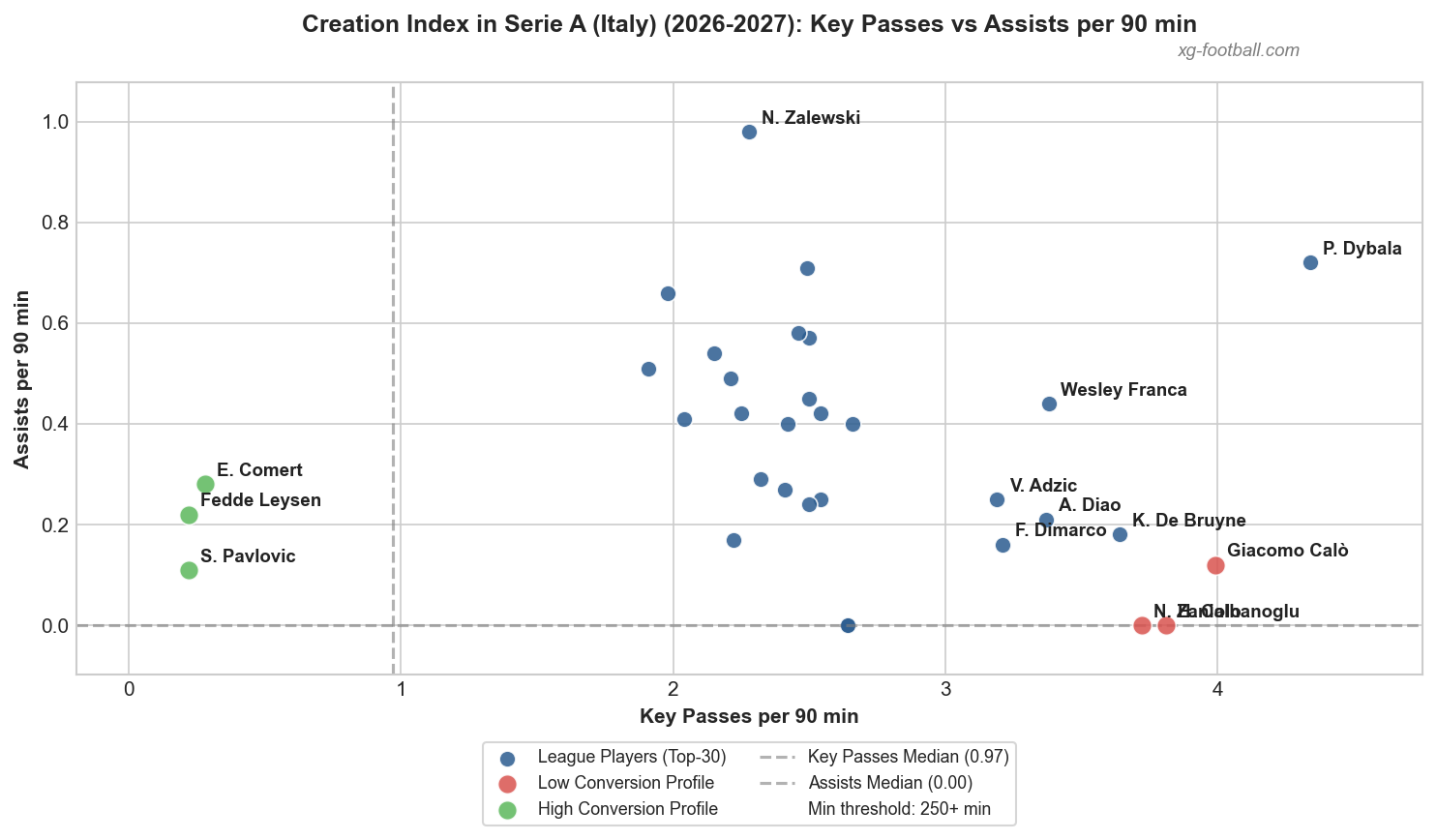
Creativity in Serie A during the 2026–27 season is concentrated among a relatively small group of players. Across the 263 footballers who have played at least 250 minutes, the median number of key passes is just 0.97 per match, while the median assists figure stands at 0.0. In other words, at least half of the players in the sample have yet to register an assist.
Against that background, the league’s leading creators stand out. Their key-pass numbers are several times higher than the typical level, demonstrating how important they are to their teams’ attacking play. But creating chances and turning them into goals are two different things — and the gap between those outcomes is one of the most interesting features of this dataset.
The Leaders: Dybala Sets the Standard
The standout playmaker is Paulo Dybala of AS Roma. The Argentine averages an impressive 4.34 key passes per match and adds 0.72 assists. His combined figure of 5.06 is the best in the entire sample. Even more striking is that he has produced these numbers in just 498 minutes, underlining how quickly he can influence Roma’s attacking rhythm.
In second place is Giacomo Calò of Frosinone. His 3.99 key passes per match put him among the league’s most active creators, but his assist average is only 0.12. With 766 minutes played, Calò has consistently been involved in chance creation, although the final statistical reward has so far been limited.
Third is Kevin De Bruyne of Napoli, averaging 3.64 key passes and 0.18 assists. His numbers reflect a strong creative contribution, even if the assist column does not yet fully capture his influence. Wesley Franca, also of Roma, is close behind with 3.38 key passes and 0.44 assists. His 0.82 combined contribution places him level with De Bruyne on the overall key-passes-plus-assists measure, despite a different balance between the two categories.
Hakan Çalhanoğlu of Inter ranks fifth with 3.81 key passes per match but no assists. His creativity is clearly visible in the volume of opportunities he helps generate, even if none have resulted in a recorded assist during this sample.
Nicolò Zaniolo of Udinese follows with 3.72 key passes and zero assists. Given his 290 minutes, the sample is relatively small, but his chance-creation rate is still notable.
The next group features Assane Diao of Como (3.37 key passes, 0.21 assists), Vasilije Adžić of Sassuolo (3.19 and 0.25), and Federico Dimarco of Inter (3.21 and 0.16). Each offers a different creative profile, combining regular involvement in attacking moves with varying levels of direct end product.
Completing the top ten is Nicola Zalewski of Atalanta. His 2.28 key passes per match are lower than those of most players above him, but his 0.98 assists are the highest figure in the group. Zalewski illustrates how a player can deliver an outstanding assist return without leading the league in overall chance creation.
The Unlucky Creators: Plenty of Chances, Few Assists
Three names stand out in the low-conversion group: Giacomo Calò (Frosinone), Hakan Çalhanoğlu (Inter), and Nicolò Zaniolo (Udinese).
Calò is perhaps the clearest example. He averages 3.99 key passes per match, yet his assist figure is only 0.12. That gap suggests that his creative work has not translated into many recorded assists. It does not necessarily mean his teammates have wasted every opportunity: key passes can lead to shots that are saved, blocked or missed, while an assist is only awarded when a goal follows.
Çalhanoğlu and Zaniolo face an even more striking statistical contrast. Both produce more than 3.7 key passes per match, but neither has registered an assist in the dataset. Their numbers point to substantial creative involvement without a corresponding return in the final column.
For Inter and Udinese, respectively, the challenge is to turn that supply of opportunities into goals. More detailed expected-assists data and shot-quality figures would help establish whether the issue lies primarily in finishing, chance quality or the nature of the opportunities created.
The Efficient Few: Making the Most of Limited Involvement
At the other end of the spectrum are players whose assist figures are surprisingly high relative to their key-pass averages.
E. Çömert of Torino records 0.28 key passes and 0.28 assists per match. Fedde Leysen of Sassuolo posts an identical balance of 0.22 in both categories. These are striking ratios, although their low key-pass volumes suggest that they should be viewed as examples of high statistical return rather than proof of consistently superior creative efficiency.
S. Pavlović of AC Milan completes the group with 0.22 key passes and 0.11 assists. His figures are more modest, but they still show that a relatively limited volume of recorded chance creation can coincide with a measurable assist return.
Small samples and differences in playing roles can have a major influence on these ratios. A player may register an assist from a relatively rare key pass, while another can create chances regularly without receiving any assist credit.
Conclusion: Creativity Is Only Half the Story
Serie A’s numbers reveal a clear divide between players who generate opportunities and those who turn a smaller volume of involvement into assists. Dybala leads the overall creative rankings, while Calò and Çalhanoğlu demonstrate how impressive key-pass numbers can coexist with modest or nonexistent assist returns. Zalewski, meanwhile, shows the value of end product, topping the top-ten group for assists despite a lower key-pass average.
The central lesson is that creativity cannot be judged by assists alone. Key passes measure the supply of opportunities; assists measure the goals that follow. The most complete playmakers are those who can deliver both — and Dybala currently sets the benchmark.