
Güler, Dybala and Muheim Lead Europe’s Creative Charts as Calhanoglu Searches for End Product
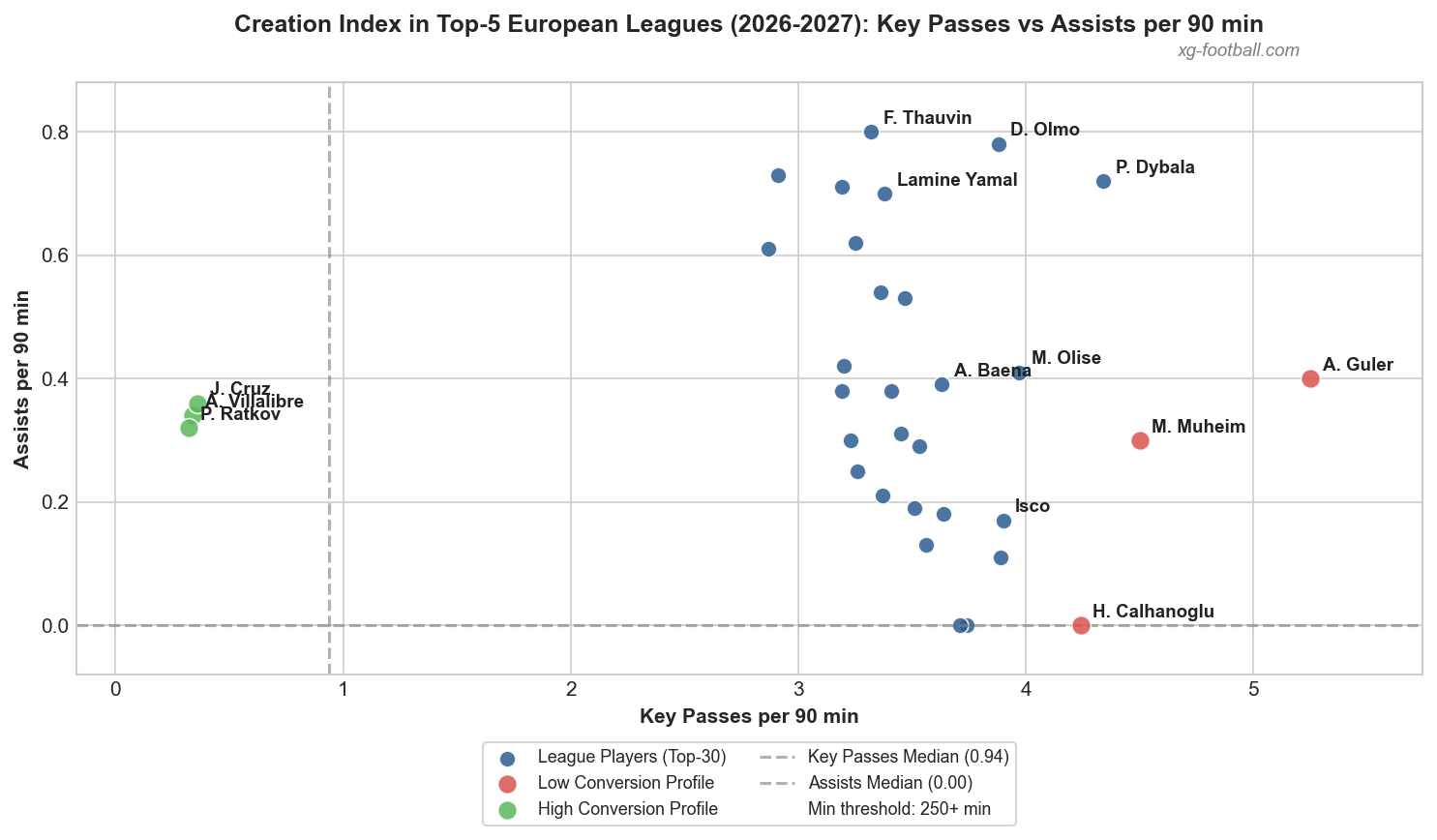
Creativity remains one of football’s most revealing measures of attacking influence. Goals capture the final outcome, but key passes show who helps build the chances that can decide matches. Across Europe’s top five leagues in the 2026–27 season, a sample of 1,271 players who have logged at least 250 minutes offers a snapshot of the players shaping attacks and those whose creative work has yet to translate into a stronger statistical return.
The league-wide median stands at 0.94 key passes, while the median for assists is 0.0. The contrast is telling: creating opportunities is a regular part of the game, but recording an assist remains much less common across the full sample. Against that baseline, the leading playmakers stand out for their ability to generate chances at a rate well above the typical player.
Güler Sets the Pace, Dybala Delivers the End Product
A. Güler of Real Madrid leads the creative ranking with 5.25 key passes and 0.4 assists, giving him a combined figure of 5.65 in the main table. Having played 669 minutes, the Turkish midfielder has established himself as one of the sample’s most active chance creators. His key-pass total is comfortably ahead of the league median, highlighting the volume of attacking opportunities he helps produce.
P. Dybala of AS Roma occupies second place with 4.34 key passes and 0.72 assists, for a combined total of 5.06. While he trails Güler in key passes, his assist figure is considerably higher. That balance points to a different creative profile: Dybala combines frequent involvement in chance creation with a stronger return in recorded assists.
M. Muheim of Hamburger SV ranks third, recording 4.5 key passes and 0.3 assists. His combined figure in the main ranking is 4.8. With 300 minutes played, his numbers are striking, although the relatively limited sample of playing time means they should be treated as an early indication rather than definitive proof of a sustained season-long trend.
D. Olmo of Barcelona follows with 3.88 key passes and 0.78 assists, producing a combined score of 4.66. His assist figure is among the strongest in the top ten and exceeds those of both Güler and Dybala. Olmo’s profile illustrates why creative influence cannot be judged by key passes alone: the ability to turn attacking involvement into recorded assists is another important part of the picture.
M. Olise of Bayern München contributes 3.97 key passes and 0.41 assists, bringing his combined total to 4.38. Just behind him in the ranking is H. Calhanoglu of Inter, whose 4.24 key passes have not yet been accompanied by an assist. The contrast between the two players highlights the different ways creative activity can appear in the statistics, even when key-pass production is high.
F. Thauvin of Lens is one of the standout names for direct output. He has recorded 3.32 key passes and 0.8 assists, giving him a combined figure of 4.12. His assist total is the highest among the ten listed players, demonstrating a particularly strong return in that category.
Lamine Yamal of Barcelona adds 3.38 key passes and 0.7 assists, with a combined score of 4.08 after 905 minutes. His presence alongside Olmo gives Barcelona two representatives in the top ten, each offering a different balance between chance creation and assists.
Isco of Real Betis records 3.9 key passes and 0.17 assists, while A. Baena of Atletico Madrid has 3.63 key passes and 0.39 assists. Isco’s key-pass figure places him among the most active creators in the sample, whereas Baena’s numbers show a more even contribution across the two metrics. Both complete a top ten featuring a broad range of creative profiles.
The Unlucky Creators: When Key Passes Do Not Become Assists
The low-conversion group features Güler, Calhanoglu and Muheim. Each produces a high volume of key passes relative to the wider sample, yet their assist totals are comparatively modest. These figures make them natural candidates for closer examination, although the statistics alone cannot prove that poor finishing by teammates is the reason for the gap.
Güler’s combination of 5.25 key passes and 0.4 assists puts him at the top of the main creative ranking. However, the low-conversion block lists his combined figure as 4.85, which conflicts with the main table. Adding the two listed components gives 5.65, matching the main ranking. The discrepancy should be noted, but it does not change the broader picture: Güler is creating chances at an exceptional rate, while his assist return remains relatively low compared with that workload.
Calhanoglu presents an even clearer statistical contrast. His 4.24 key passes are accompanied by zero assists. The Inter midfielder is regularly involved in creating opportunities, but none of those efforts has resulted in a recorded assist in the supplied data. That gap could reflect teammates’ finishing, the nature of the chances created or other factors affecting whether a pass is credited as an assist. More detailed chance-quality and shot-conversion data would be needed to identify the cause with confidence.
Muheim’s figures tell a similar story: 4.5 key passes and 0.3 assists. His main-table combined total is 4.8, whereas the low-conversion block gives 4.2. The arithmetic sum of the listed components is 4.8, so the lower figure appears inconsistent with the underlying data. Even with that discrepancy, Muheim’s high key-pass output and modest assist figure make him one of the sample’s most notable creative outliers.
Low Volume, Strong Return? The Other Side of the Numbers
The high-conversion group includes J. Cruz of Malaga, A. Villalibre of Racing Santander and P. Ratkov of Levante. Their key-pass and assist figures match exactly: 0.36 and 0.36 for Cruz, 0.34 and 0.34 for Villalibre, and 0.32 and 0.32 for Ratkov.
However, the combined totals supplied for all three players are listed as zero, which does not match the component figures. Adding the values gives 0.72 for Cruz, 0.68 for Villalibre and 0.64 for Ratkov. These corrected sums are simple arithmetic, not evidence that the players are necessarily the most efficient creators in Europe. Their figures suggest a different statistical profile from the high-volume leaders, but a reliable efficiency comparison would require more context, including minutes played, chance quality and the consistency of their output.
The matching key-pass and assist figures make the trio unusual within this dataset. Still, low key-pass totals do not automatically mean that a player is more efficient or fortunate. They may reflect a different role, fewer opportunities to create or a smaller sample. Without further information, the strongest conclusion is that their listed assist rates match their key-pass rates, not that they have definitively outperformed the leading playmakers.
Two Routes to Creative Influence
The rankings reveal two broad ways to influence an attack. Güler, Dybala and Muheim stand out for the volume of chances they help create, while Thauvin, Yamal and Olmo combine strong key-pass numbers with comparatively high assist totals. Neither profile tells the whole story on its own. Key passes capture an important part of the build-up to a scoring opportunity, while assists record a specific outcome of that creative work.
With the league median at 0.94 key passes and 0.0 assists, the leading creators are operating well above the typical level in at least one of these categories. Yet the figures also underline the need for careful interpretation. A key pass does not guarantee a goal, and a lack of assists does not by itself prove that teammates are wasting chances. In addition, several combined totals in the supplied data do not match the sum of their components.
Even with those limitations, the sample identifies a compelling group of attacking influences. Güler leads the overall creative ranking, Dybala offers a strong blend of chance creation and assists, and Thauvin stands out for his assist return. Meanwhile, Calhanoglu and Muheim illustrate how substantial creative involvement can coexist with a more modest recorded outcome. As the season progresses and the sample grows, these profiles will offer a useful way to track which players sustain their creative influence and which turn more of it into direct attacking returns.