
Ligue 1 2026/27: Esteban Lepaul leads the attacking charts as Marquinhos stands out for efficiency
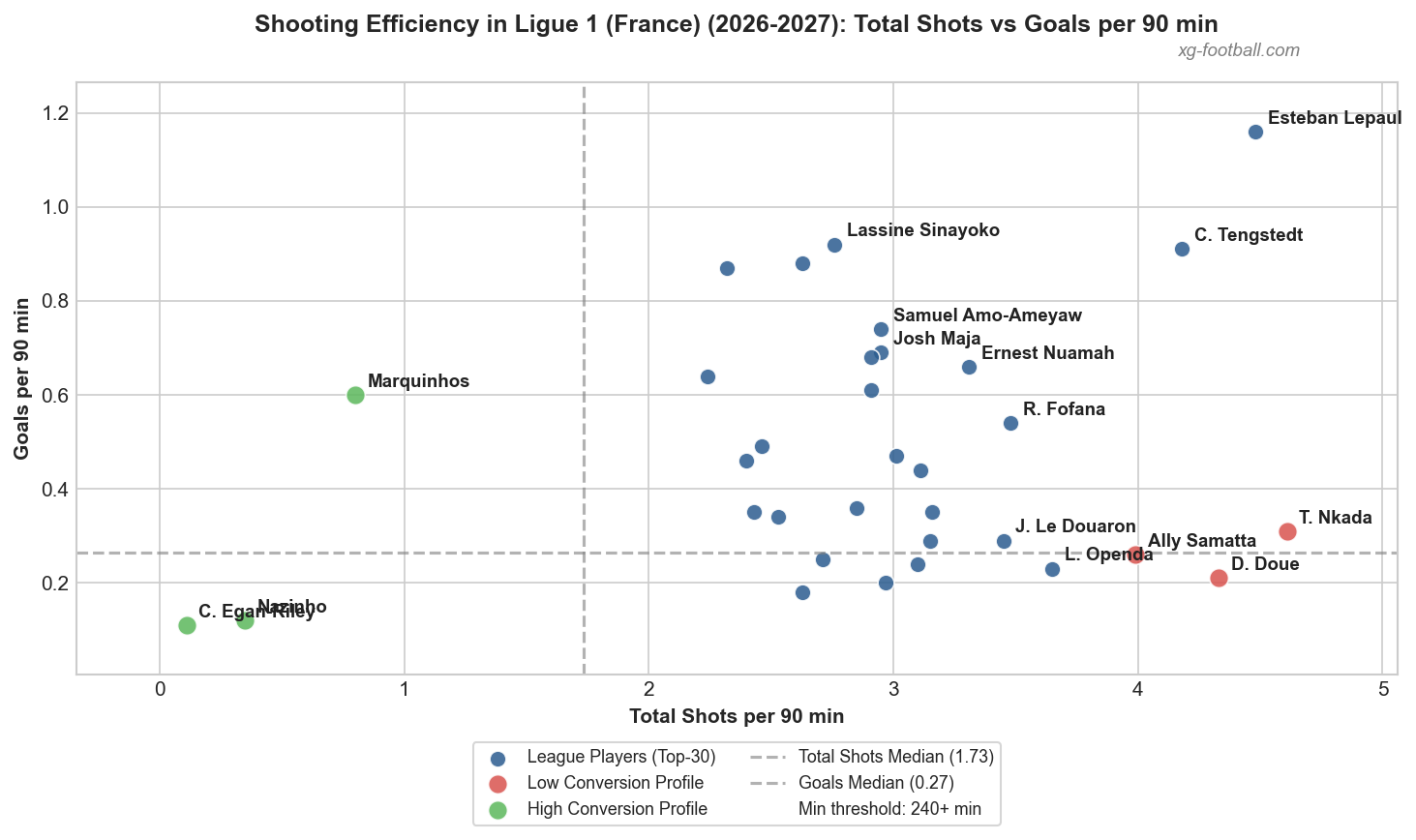
The early statistical picture of the 2026/27 Ligue 1 season reveals a fascinating contrast between attacking volume and finishing efficiency. Across a sample of 110 players who have played at least 240 minutes, the league median stands at 1.74 total shots and 0.26 goals. Against those benchmarks, several players are producing attacking numbers well above the norm, while others are finding ways to make a significant impact with fewer attempts.
At the top of the combined shots-and-goals ranking, Esteban Lepaul of Rennes leads the field with a score of 5.64, followed by C. Tengstedt of Toulouse on 5.09. Yet the numbers tell more than a simple story of attacking dominance. T. Nkada of Estac Troyes is taking more shots than anyone else in the top 12, while Marquinhos of Paris Saint-Germain stands out for his goals relative to his shooting volume. These contrasting profiles make the data particularly revealing.
The leaders: Lepaul and Tengstedt set the pace
Esteban Lepaul is the standout performer in the sample. Playing 543 minutes for Rennes, he averages 4.48 shots and 1.16 goals, producing a combined figure of 5.64. Both numbers comfortably exceed the league medians, making him the clearest example of a player combining frequent attempts with a strong scoring return. His figures put him ahead of every other player in the supplied ranking.
C. Tengstedt of Toulouse occupies second place with 4.18 shots and 0.91 goals across 495 minutes. His combined score of 5.09 leaves him as the only other player in the top 12 to break the five-point mark. While his shot volume is slightly below Lepaul's, his goal output remains impressive relative to the league median. The pair currently define the benchmark for the most productive attacking profiles in this dataset.
Third place belongs to T. Nkada of Estac Troyes, whose 4.61 shots per game-related statistical interval is the highest figure among the leading 12 players. His goals figure, however, stands at 0.31, leaving him well behind the top two in scoring output. The contrast suggests a player heavily involved in finishing moves who could improve his overall contribution if a greater share of his attempts were converted.
D. Doue of Paris Saint-Germain ranks fourth, recording 4.33 shots and 0.21 goals over 436 minutes. His shooting activity is among the strongest in the sample, but his goals figure sits below the league median of 0.26. That gap makes his profile one to watch: the attacking involvement is already evident, but the scoring return has yet to match the volume of attempts.
Ally Samatta of Le Havre presents a similar pattern. Across 700 minutes, he averages 3.99 shots and 0.26 goals. His shot volume is well above the median, while his goals figure sits exactly on the league benchmark. Samatta is clearly involved in attacking play, but his current numbers suggest that increased efficiency could make a substantial difference to his overall output.
Le Havre also feature another member of the top group in R. Fofana, who has recorded 3.48 shots and 0.54 goals in 336 minutes. Unlike Samatta, Fofana combines a high volume of attempts with a goals figure comfortably above the median. His numbers offer a more balanced attacking profile, although the relatively limited minutes mean that further matches will be important in assessing how sustainable the trend is.
Ernest Nuamah of Lyon is another notable performer. With 3.31 shots and 0.66 goals across 543 minutes, he produces a strong scoring figure while remaining well above the median in shooting activity. Teammate L. Openda records even more shots, at 3.65, but his goals figure is 0.23. The contrast between the two Lyon players highlights how similar levels of attacking involvement can lead to different statistical returns.
J. Le Douaron of Estac Troyes adds 3.45 shots and 0.29 goals to the ranking. His scoring figure is slightly above the median, and his shooting volume is close to twice the league benchmark. Further down the list, Samuel Amo-Ameyaw of Strasbourg has 2.95 shots and 0.74 goals in 244 minutes, while Lassine Sinayoko of Paris FC records 2.76 shots and 0.92 goals across 782 minutes. Both stand out for their goal output relative to their shot volume, though Amo-Ameyaw's shorter playing time calls for particular caution when interpreting his rates.
The top 12 is completed by Josh Maja of Le Havre, with 2.95 shots and 0.69 goals in 519 minutes. His numbers are above the league median in both categories, underlining the depth of Le Havre's representation in the attacking rankings. Overall, the leading group includes players who create a high volume of attempts as well as those whose scoring figures are particularly strong relative to their shooting activity.
The anomalies: high volume, modest returns
The clearest low-conversion profiles belong to T. Nkada of Estac Troyes, D. Doue of Paris Saint-Germain and Ally Samatta of Le Havre. All three are shooting substantially more often than the league median, but their goals figures are comparatively modest. Nkada leads the top 12 for shots with 4.61, yet records 0.31 goals. Doue has 4.33 shots and 0.21 goals, while Samatta combines 3.99 shots with 0.26 goals.
These figures do not automatically mean that the players are performing poorly. High shot totals can reflect frequent involvement in attacks, and finishing outcomes depend on factors such as shot quality, location and defensive pressure. Nevertheless, the gap between attempts and goals is worth monitoring. If these players continue to generate opportunities at a similar rate, improvements in finishing could significantly raise their attacking output.
L. Openda of Lyon also merits attention from this perspective. His 3.65 shots are well above the median, but his goals figure of 0.23 falls slightly short of the league benchmark. In statistical terms, his attacking involvement is more impressive than his current scoring return. As with the other players in this category, the available figures alone cannot establish whether the issue is finishing, shot quality or circumstances beyond the player's control.
Efficiency: Marquinhos makes fewer attempts count
At the other end of the spectrum, Marquinhos of Paris Saint-Germain records 0.8 shots and 0.6 goals. His shot volume is below the league median, yet his goals figure is more than double the median of 0.26. This is one of the most striking contrasts in the data: a relatively modest number of attempts accompanies a strong scoring rate.
Nazinho of Monaco also appears in the high-conversion group, with 0.35 shots and 0.12 goals. Both figures are below the league medians, but the relationship between his shot volume and goals output places him among the players identified for efficiency. His comparatively low totals also mean that a small number of events could have a substantial influence on the rates, so a longer sample would help clarify the pattern.
C. Egan-Riley of Marseille is listed with 0.11 shots and 0.11 goals. The supplied combined figure is 0.0, but the arithmetic sum of the two listed statistics is 0.22. The discrepancy means that the combined figure should not be used as provided. The individual values can still be described, although the limited numbers make it difficult to draw firm conclusions about his long-term efficiency.
It is also important to distinguish apparent efficiency from proven finishing ability. A high goals figure relative to shots may reflect excellent execution, but it can also be influenced by the quality of chances, a player's role or a short period of unusually favourable outcomes. The current data identifies interesting profiles rather than proving that any player is definitively lucky or consistently clinical.
What the numbers tell us about Ligue 1
The statistical picture points to two broad routes to attacking influence. Esteban Lepaul and C. Tengstedt combine high shot volume with strong scoring figures, while players such as Marquinhos, Lassine Sinayoko and Samuel Amo-Ameyaw stand out for their goal output relative to their shooting volume. Meanwhile, T. Nkada, D. Doue and Ally Samatta illustrate how frequent attempts do not always translate into a proportionate return in goals.
The league medians of 1.74 shots and 0.26 goals provide a useful baseline for interpreting those differences. Players exceeding both benchmarks show strength in attacking volume and output, while those recording many shots but fewer goals may have room to improve their return. Players with lower shot totals and stronger goal figures, meanwhile, warrant closer examination as the season develops.
The sample should still be treated as a snapshot rather than a final verdict. Although every player included has reached the 240-minute threshold, playing time varies considerably, from Samuel Amo-Ameyaw's 244 minutes to Lassine Sinayoko's 782. A fuller assessment would benefit from additional information on chance quality, shot locations and performance over a longer period.
For now, Esteban Lepaul leads the combined ranking, with C. Tengstedt close behind. T. Nkada is the most active shooter among the top 12, while Marquinhos offers one of the clearest examples of a strong scoring figure alongside modest shot volume. The tension between attacking activity and finishing efficiency is the defining feature of this Ligue 1 statistical snapshot.