
Bundesliga 2026/27: Ismael Saibari leads the attacking charts as Patrik Schick and Niclas Füllkrug deliver the goals
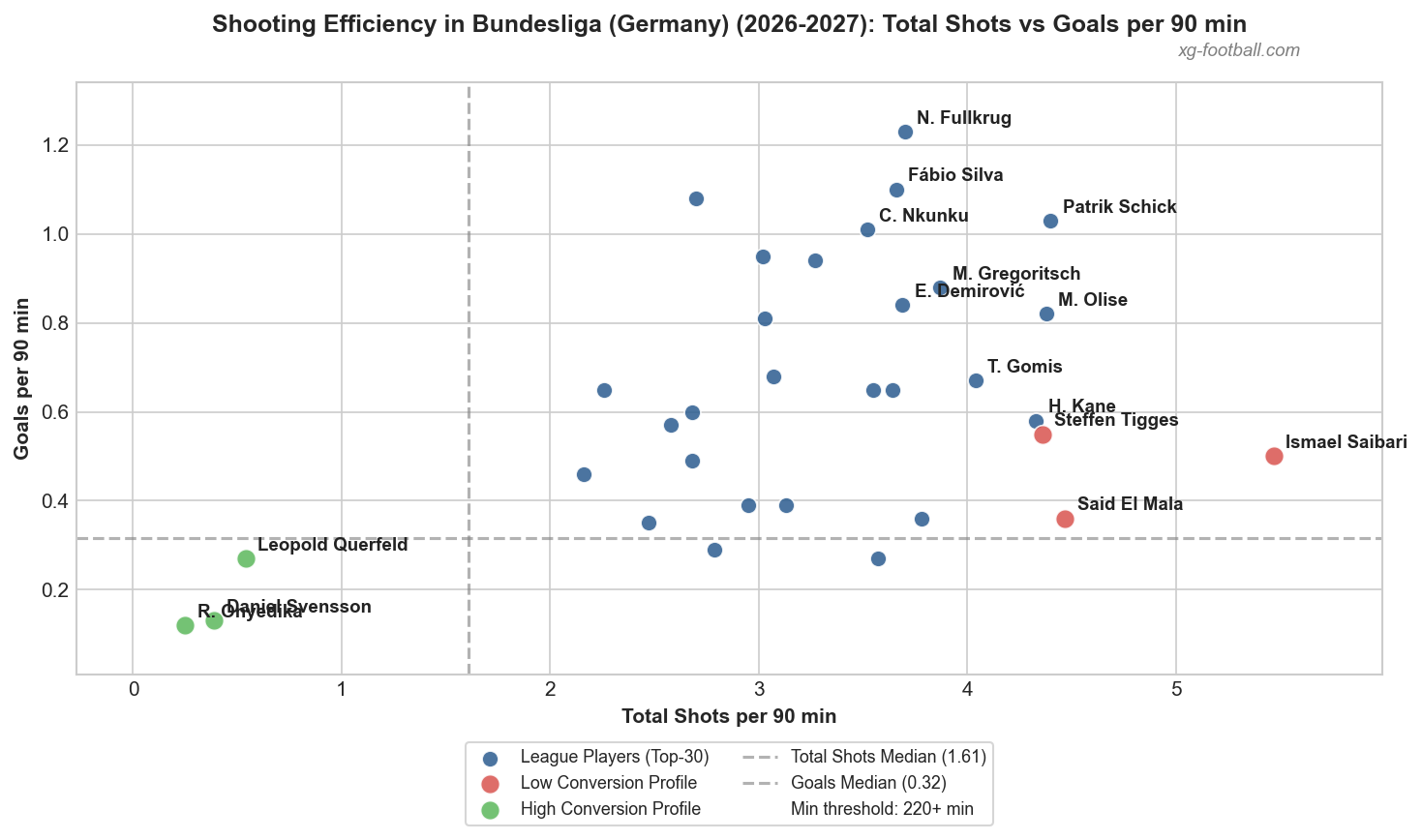
The Bundesliga's attacking numbers for the 2026/27 season reveal a compelling mix of relentless shooting, clinical finishing and players still searching for a better return on their efforts. Across a sample of 102 players who have played at least 220 minutes, the league median stands at 1.61 total shots and 0.32 goals. These benchmarks provide a useful baseline for identifying players who are consistently involved in attacking moves and those who turn their opportunities into goals.
At the top of the combined shots-and-goals ranking, Ismael Saibari of Bayern München leads with 5.97, ahead of Patrik Schick of Bayer Leverkusen on 5.43 and M. Olise of Bayern München on 5.20. But the rankings tell different stories. Saibari is the most active shooter among the leading 12, while N. Füllkrug of Werder Bremen boasts the highest goals figure in the group. Elsewhere, a handful of players show intriguing scoring returns despite relatively low shot volumes.
The leaders: Saibari sets the pace, Schick brings the finishing touch
Ismael Saibari occupies first place with 5.47 shots and 0.50 goals across 362 minutes for Bayern München. His shot rate is more than three times the league median, making him the most active shooter in the top 12. However, his goals figure is less spectacular than those of several players immediately behind him. Saibari's profile is built on attacking involvement and frequent attempts, with the potential for a stronger scoring return if that activity translates into more goals.
Patrik Schick of Bayer Leverkusen ranks second with 4.40 shots and 1.03 goals in 614 minutes. His combined score of 5.43 reflects a strong balance between volume and output. Schick is comfortably above the league median in both categories, and his goals figure places him among the most productive finishers in the sample. While Saibari leads on shooting volume, Schick offers a more complete combination of frequent attempts and a substantial scoring return.
Third place belongs to M. Olise of Bayern München, who has recorded 4.38 shots and 0.82 goals across 657 minutes. His combined figure of 5.20 puts him firmly among the leading attacking performers. Olise's numbers are close to Schick's in shooting volume, while his goal rate is also well above the league median. Together with Saibari, he highlights the range of attacking profiles available to Bayern in this sample.
N. Füllkrug of Werder Bremen sits fourth, but his goals figure deserves special attention. He averages 3.70 shots and 1.23 goals across 656 minutes, the highest goals figure among the 12 leaders. His shot volume is lower than that of the top three, yet his scoring return is stronger than anyone else's in the group. That combination makes Füllkrug one of the most striking examples of production without leading the chart in attempts.
H. Kane of Bayern München follows with 4.33 shots and 0.58 goals in 624 minutes, giving him a combined figure of 4.91. His shooting activity is comparable to that of the leading names, and his goals figure is comfortably above the median. Steffen Tigges of SC Paderborn 07 has almost identical combined output, also scoring 4.91, through 4.36 shots and 0.55 goals in 330 minutes. Tigges has produced those numbers in considerably less playing time, although a larger sample would help establish how consistently he can sustain that rate.
Said El Mala of 1. FC Köln is seventh with 4.47 shots and 0.36 goals. His shooting figure is among the highest in the entire top 12, but his goals number is only slightly above the league median. The contrast suggests that he is regularly involved in attempts on goal without yet matching the scoring output of the most productive players.
Fábio Silva of Borussia Dortmund has recorded 3.66 shots and 1.10 goals in 246 minutes. His combined score of 4.76 puts him eighth, while his goals figure is second only to Füllkrug's in the top 12. The limited playing time makes his numbers especially eye-catching, but also calls for caution: strong rates over a relatively short spell can change quickly as more minutes accumulate.
The next places belong to players with slightly different strengths. M. Gregoritsch of FC Augsburg has 3.87 shots and 0.88 goals in 512 minutes, combining above-median shooting activity with a strong scoring return. T. Gomis of RB Leipzig records 4.04 shots and 0.67 goals across 401 minutes, leaning more heavily on shot volume. Both have established themselves above the league benchmarks in both categories.
The top 12 is completed by E. Demirović of VfB Stuttgart and C. Nkunku of RB Leipzig, each with a combined score of 4.53. Demirović averages 3.69 shots and 0.84 goals across 536 minutes. Nkunku has 3.52 shots and 1.01 goals in 358 minutes. Nkunku's scoring figure is particularly notable: despite a lower shot rate than many of the players above him, he has reached the one-goal mark in the supplied data.
The anomalies: plenty of attempts, not always enough goals
The clearest low-conversion profile belongs to Ismael Saibari of Bayern München. His 5.47 shots are the highest figure in the top 12, but his goals rate of 0.50 falls well short of the leaders' best returns. This does not necessarily point to poor performances. A high shot count can reflect constant involvement in the final third, while the eventual outcome depends on the quality of chances, shooting positions and defensive pressure. Still, Saibari's numbers leave room for his scoring output to catch up with his attacking activity.
Said El Mala of 1. FC Köln presents a similar contrast. He averages 4.47 shots but only 0.36 goals, barely above the league median of 0.32. His frequent attempts suggest that he is regularly getting into positions to finish attacks, yet the scoring return remains modest compared with the volume of shots. If he can maintain that level of involvement while improving his finishing, his overall contribution could rise significantly.
Steffen Tigges of SC Paderborn 07 also features in the low-conversion category, with 4.36 shots and 0.55 goals. His goals figure is higher than those of Saibari and El Mala, but the supplied classification highlights the difference between his shooting volume and the output expected from such frequent attempts. With only 330 minutes played, it is too early to draw a definitive conclusion about his finishing, but his profile will be worth monitoring as his sample grows.
These players should not automatically be labelled unlucky or wasteful. The data does not show whether their shots were high-quality chances or difficult attempts from poor positions. It does, however, identify a group whose attacking volume is much more impressive than their current goal return. That gap is one of the most useful trends to track over the coming weeks.
Efficiency: Onyedika, Svensson and Querfeld stand out
At the other end of the spectrum, R. Onyedika of Eintracht Frankfurt records 0.25 shots and 0.12 goals. Both figures sit below the league medians, but his inclusion in the high-conversion category points to a comparatively notable goal return relative to his low shooting volume. His numbers suggest that he does not frequently finish attacks, making the relationship between attempts and goals particularly sensitive to a small number of events.
Daniel Svensson of Borussia Dortmund has 0.39 shots and 0.13 goals. His absolute scoring figure is modest, but it is paired with a low volume of attempts. The profile differs sharply from that of Saibari or El Mala: instead of generating a high number of shots with a limited goal return, Svensson appears in the data as a player whose output is relatively strong in relation to his shooting frequency.
Leopold Querfeld of Union Berlin records 0.54 shots and 0.27 goals. His goals figure comes close to the league median, despite his shot rate remaining well below the benchmark of 1.61. Among the three players in this category, Querfeld has the highest shooting figure and the strongest absolute goals rate. His numbers make him an interesting example of a player producing a measurable scoring contribution without a high volume of attempts.
Nevertheless, efficiency over a limited sample should not be confused with proof of exceptional finishing or good fortune. A low number of shots can magnify the impact of individual goals, and the supplied data does not include chance quality or shot location. The figures identify players worth watching, rather than establishing that their current scoring rates will necessarily continue.
What the numbers reveal about the Bundesliga
The rankings point to two broad routes to attacking production. Ismael Saibari, M. Olise and H. Kane of Bayern München are prominent for their high shooting volume. Patrik Schick, N. Füllkrug and C. Nkunku, meanwhile, combine strong shot numbers with particularly impressive goals figures. The best attacking profiles are not defined by one statistic alone: both the frequency of attempts and the return they produce matter.
The league medians of 1.61 shots and 0.32 goals provide a useful point of comparison. Every player in the top 12 is well above the median in shots, while most also exceed the goals benchmark. The exceptions and near-exceptions are especially revealing: Saibari and El Mala show how high activity can coexist with more modest scoring, while the efficiency group demonstrates that players with fewer attempts can still contribute goals.
Playing time is another important consideration. The sample ranges from 246 minutes for Fábio Silva to 657 for M. Olise. Rates built on shorter spells can be more volatile, so Silva's impressive scoring figure should be revisited as he accumulates more minutes. The same principle applies to other players whose profiles may shift substantially over a longer stretch of the season.
For now, Ismael Saibari leads the combined ranking through sheer attacking activity, Patrik Schick offers one of the strongest blends of volume and goals, and N. Füllkrug tops the leading group for scoring output. Meanwhile, Said El Mala and Steffen Tigges illustrate the gap that can emerge between shooting frequency and goals, while R. Onyedika, Daniel Svensson and Leopold Querfeld provide alternative profiles built around relatively low shot volume. The contrast between attacking intent and end product is what makes this Bundesliga snapshot so compelling.