
Serie A 2026/27: Ndri Leads the Dribbling Charts as Cambiaghi Emerges as a Foul-Winning Specialist
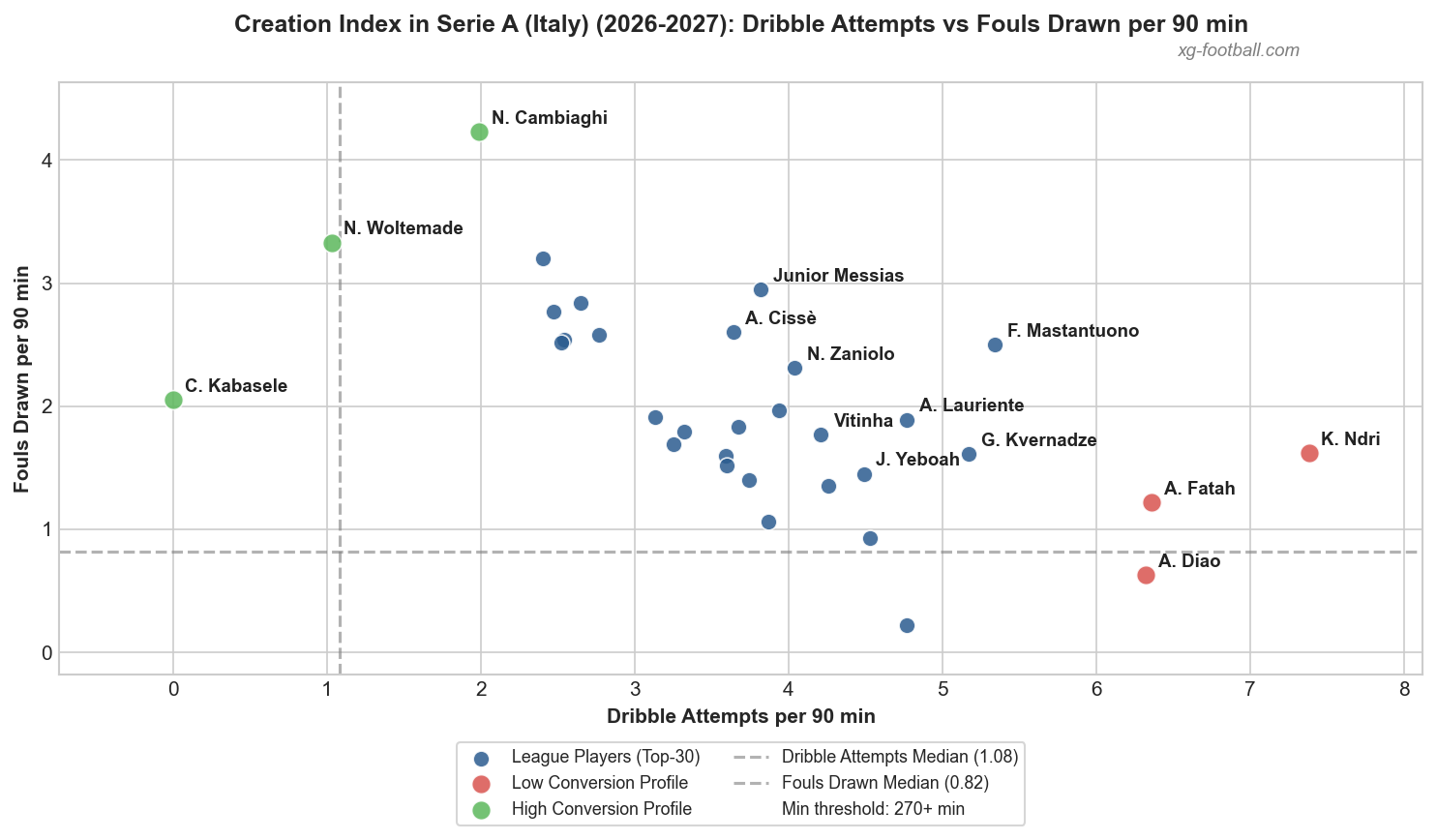
Creativity in modern football is about more than goals, assists and spectacular passes. The ability to beat an opponent one-on-one, carry the ball into dangerous areas and force defenders into committing fouls can be just as important in building attacking momentum. The Serie A statistics for the 2026/27 season reveal which players are making the biggest individual impact in these areas — and some of the findings are particularly intriguing.
The analysis covers 290 players, each of whom has played at least 270 minutes. The league median stands at 1.08 dribble attempts and 0.82 fouls drawn. These figures provide a useful benchmark for measuring attacking involvement. Players significantly above both marks are more frequently involved in one-on-one situations and regularly force opposing defenders into difficult decisions.
However, the numbers also reveal different creative profiles. Some players constantly look to beat their markers, while others are more effective at winning free kicks without relying on repeated dribbling. The leading names demonstrate that there is more than one way to influence an attacking phase.
The Leaders: Ndri Takes Top Spot as Lecce Make Their Mark
K. Ndri of Lecce tops the ranking with a combined figure of 9.00, recording 7.38 dribble attempts and 1.62 fouls drawn. His dribbling volume is comfortably the highest among the 12 players listed. Across 500 minutes, Ndri has demonstrated a clear willingness to take responsibility in possession, repeatedly challenging defenders and looking to advance the ball through individual skill.
F. Mastantuono of Fiorentina occupies second place with 7.84. His figures are more balanced: 5.34 dribble attempts and 2.50 fouls drawn in 792 minutes. He combines direct attacking play with an ability to attract defensive contact, making him one of the most versatile profiles in the ranking.
Third place belongs to A. Fatah of Lecce, who has accumulated 7.58. His 6.36 dribble attempts and 1.22 fouls drawn came in just 368 minutes. Lecce therefore have two players in the top three, highlighting the individual attacking activity of both Ndri and Fatah.
A. Diao of Como follows in fourth with 6.95. His 6.32 dribble attempts are among the highest in the competition, although his 0.63 fouls drawn indicate that his attacking influence is based more heavily on taking on opponents than winning free kicks.
Fifth place goes to G. Kvernadze of Frosinone, whose combined score of 6.78 comes from 5.17 dribble attempts and 1.61 fouls drawn. His 836 minutes are the highest total among the top five, demonstrating sustained involvement across a significant amount of playing time.
Junior Messias of Genoa is close behind with 6.77. His 3.82 dribble attempts are complemented by an impressive 2.95 fouls drawn. This is a particularly interesting combination: Messias does not need to attempt as many take-ons as the leading dribblers to generate defensive pressure and win free kicks.
The next positions belong to A. Lauriente of Sassuolo (6.66) and N. Zaniolo of Udinese (6.35). A. Cissè of AC Milan follows with 6.24, while N. Cambiaghi of Bologna completes the top ten with 6.22. Cambiaghi's profile is especially distinctive, as his 4.23 fouls drawn significantly exceed his 1.99 dribble attempts.
The final two places in the top 12 go to Vitinha of Genoa, with 5.98, and J. Yeboah of Venezia, with 5.94. The variety of clubs represented underlines how widely individual attacking creativity is distributed across Serie A.
The Anomalies: High Workload Does Not Always Mean More Fouls
Some players feature prominently because of their willingness to attempt dribbles, yet their numbers of fouls drawn are comparatively modest. This low-conversion profile highlights a difference between individual attacking activity and the ability to turn defensive pressure into free kicks.
K. Ndri of Lecce appears in this category as well as at the top of the overall ranking. His 7.38 dribble attempts are accompanied by 1.62 fouls drawn, leaving a difference of 5.76. This suggests that he relies heavily on direct attempts to beat opponents rather than regularly forcing them into committing fouls.
A. Diao of Como shows a similar pattern. He records 6.32 dribble attempts but draws just 0.63 fouls, producing a difference of 5.69. His individual activity is clear, although relatively few of those situations result in a foul being awarded in his favour.
A. Fatah of Lecce completes the group with 6.36 dribble attempts and 1.22 fouls drawn. The difference of 5.14 places him among the players whose attacking workload is considerably higher than their return in terms of free kicks won.
It is important not to interpret these figures as proof that teammates are wasting the chances created by these players. Dribble attempts and fouls drawn do not measure shot quality, assists, expected goals or finishing efficiency. They describe individual involvement and the relationship between attempted take-ons and fouls won, rather than the final outcome of an attacking move.
Efficiency Specialists: Cambiaghi and Woltemade Win Contact Without Constant Dribbling
At the opposite end of the spectrum are players who draw a substantial number of fouls despite attempting relatively few dribbles. Their profiles suggest a different kind of attacking effectiveness, built around positioning, timing, body movement and the ability to protect possession under pressure.
N. Woltemade of Juventus is a clear example. He averages just 1.03 dribble attempts but draws an impressive 3.33 fouls. The difference between the two figures is −2.30, indicating that he wins considerably more fouls than his dribbling volume might suggest.
N. Cambiaghi of Bologna produces an even more striking return. His 1.99 dribble attempts are accompanied by 4.23 fouls drawn, the highest figure among all players in this profile. Across 724 minutes, he has demonstrated an ability to attract defensive challenges without relying on a particularly high volume of take-ons.
C. Kabasele of Udinese completes the group with 2.05 fouls drawn despite recording zero dribble attempts. His example is a reminder that winning free kicks does not necessarily require taking on defenders. Positioning, physical presence and movement in contested areas can be equally important.
These players offer their teams a different kind of attacking value. Winning fouls can help a side move up the pitch, relieve defensive pressure, disrupt an opponent's rhythm and create opportunities from set pieces. In that sense, Woltemade, Cambiaghi and Kabasele provide an interesting contrast to the direct dribbling approach of Ndri and Fatah.
What the Numbers Tell Us About Serie A Creativity
The 2026/27 statistics reveal several distinct attacking profiles. K. Ndri of Lecce leads the overall ranking through sheer dribbling activity, while F. Mastantuono of Fiorentina offers a more balanced combination of take-ons and fouls won. Junior Messias of Genoa also stands out for his ability to draw contact, while N. Cambiaghi of Bologna is particularly effective at winning fouls without attempting a large number of dribbles.
The contrast between high-volume dribblers and foul-winning specialists demonstrates why creativity cannot be reduced to a single statistic. Some players create pressure through repeated one-on-one challenges; others use movement, positioning and physical awareness to make defenders commit mistakes.
With league medians of 1.08 dribble attempts and 0.82 fouls drawn, the leading players operate well above the typical level in at least one category. Their contrasting styles offer a fascinating snapshot of attacking football in Italy — where individual skill, intelligent movement and the ability to draw defensive contact all contribute to creating opportunities.