
K. Ndri Leads Serie A’s Dribbling Charts as Lecce Dominate the Individual Creativity Rankings
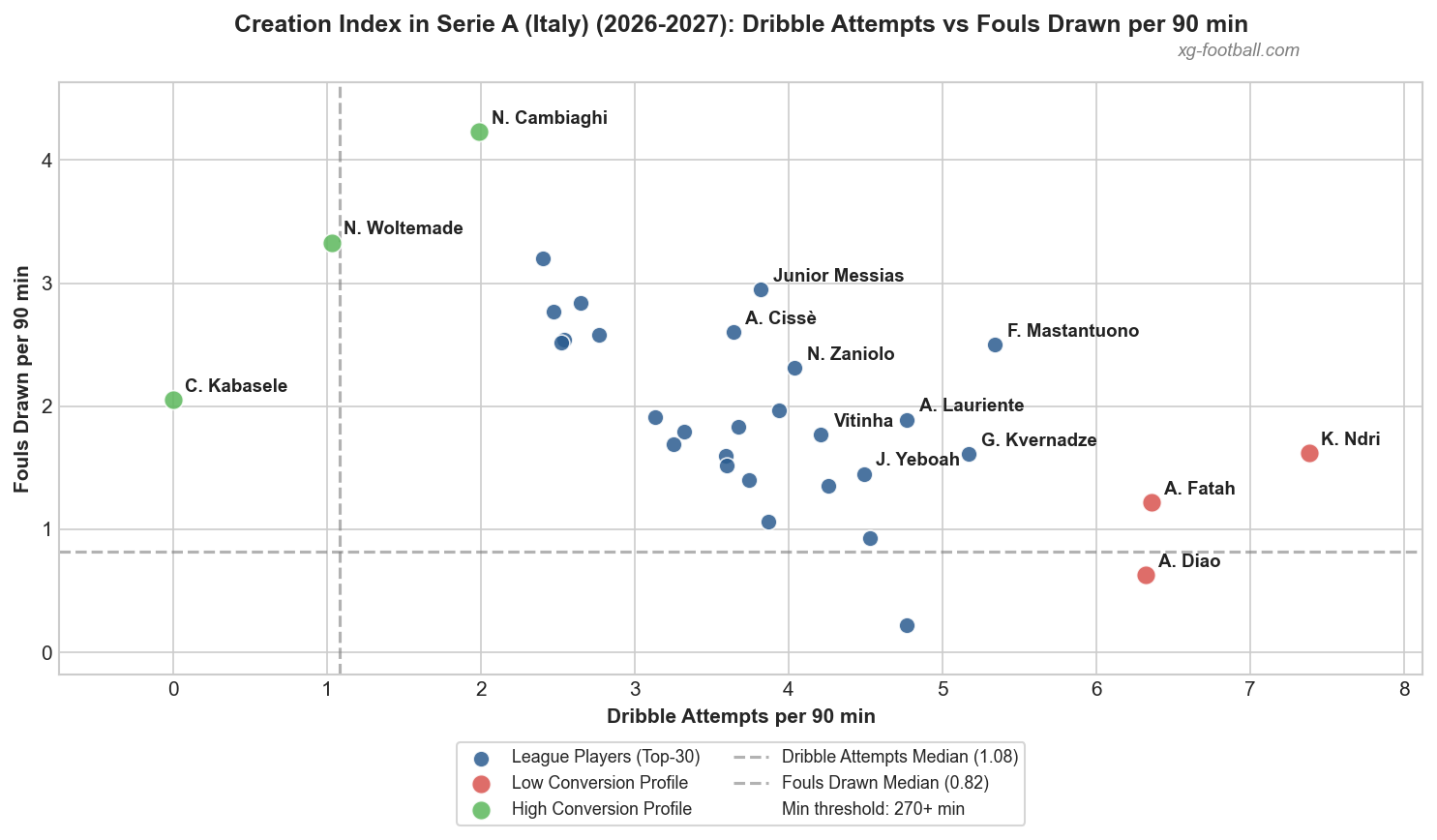
Individual creativity in modern football is about much more than goals and assists. The ability to beat opponents in one-on-one situations, carry the ball into dangerous areas and draw fouls under pressure can be just as important in breaking down defensive structures. Serie A’s 2026/27 statistics reveal a fascinating contrast between players who constantly look to take defenders on and those who know how to turn limited attacking actions into valuable free kicks.
The study covers 290 players who have played at least 270 minutes. The league median stands at 1.08 dribble attempts per 90 minutes, while the median for fouls drawn is 0.82. These figures provide a useful benchmark for evaluating individual attacking involvement across the competition.
The numbers suggest that frequent dribbling is far from universal in Serie A. However, a select group of players operate at a completely different level, repeatedly challenging defenders and creating situations that force opponents into difficult decisions. Others take a more economical approach, relying on positioning, close control and physical contact to win free kicks. The resulting rankings highlight several distinct styles of attacking influence.
K. Ndri sets the pace as Lecce produce two of the league’s leading dribblers
The standout performer is K. Ndri (Lecce), whose 7.38 dribble attempts per 90 minutes place him comfortably at the top of the rankings. That figure is more than six times the league median, underlining just how frequently he looks to take responsibility in individual attacking situations.
Ndri also averages 1.62 fouls drawn per 90 minutes, giving him a combined dribbling-and-fouls figure of 9.00 — the highest among all players in the study. Across 500 minutes, his numbers point to an exceptionally direct attacking profile. He is constantly willing to challenge defenders, carry the ball forward and attempt to create an advantage through individual skill.
His teammate A. Fatah (Lecce) provides further evidence of the club’s attacking ambition. With 6.36 dribble attempts and 1.22 fouls drawn per 90 minutes, Fatah ranks third overall with a combined score of 7.58. Having accumulated 368 minutes, he has already established himself as one of the most active individual attackers in the competition.
The presence of two Lecce players in the top three is particularly striking. Both demonstrate a willingness to attack defenders directly, suggesting that individual initiative is an important feature of the club’s attacking approach. Their profiles are similar in terms of dribbling volume, although neither currently draws fouls at a rate comparable to some of the league’s specialists in that area.
Between the two Lecce players sits F. Mastantuono (Fiorentina). His combined figure of 7.84 makes him the second-ranked player in the competition. Mastantuono averages 5.34 dribble attempts and 2.50 fouls drawn per 90 minutes, producing a particularly balanced profile. Unlike Ndri, whose game is heavily driven by dribbling volume, Mastantuono combines frequent one-on-one challenges with a strong ability to force defensive mistakes.
Another major contributor is A. Diao (Como), who records 6.32 dribble attempts per 90 minutes. His combined total of 6.95 places him fourth. However, his fouls-drawn figure of just 0.63 is notably low. Diao clearly prefers to attack through direct ball-carrying rather than relying on contact to win free kicks.
G. Kvernadze (Frosinone) occupies fifth place with a combined score of 6.78. His 5.17 dribble attempts and 1.61 fouls drawn suggest a productive balance between direct attacking play and the ability to win free kicks. With 836 minutes played, he also has one of the larger workloads among the leading players, making his figures particularly interesting.
Just behind him is Junior Messias (Genoa), whose combined score of 6.77 is built on a different foundation. He averages 3.82 dribble attempts but draws an impressive 2.95 fouls per 90 minutes. This makes him one of the competition’s most effective players at turning attacking situations into defensive infringements.
A. Lauriente (Sassuolo) follows with 4.77 dribble attempts and 1.89 fouls drawn, producing a combined figure of 6.66. His numbers suggest a direct winger who combines frequent attempts to beat opponents with a consistent ability to win free kicks.
The remaining positions in the top 12 reveal even more variety. N. Zaniolo (Udinese) records 4.04 dribble attempts and 2.31 fouls drawn, reaching 6.35. A. Cissè (AC Milan) follows with 3.64 and 2.60 respectively, while N. Cambiaghi (Bologna) stands out with just 1.99 dribble attempts but an outstanding 4.23 fouls drawn.
Vitinha (Genoa) contributes 4.21 dribble attempts and 1.77 fouls drawn, giving him a combined score of 5.98. Finally, J. Yeboah (Venezia) completes the top 12 with 4.49 attempts and 1.45 fouls drawn, reaching 5.94.
The unlucky dribblers: enormous workload, limited return in fouls won
Not every player who constantly takes on defenders receives the same reward for their attacking involvement. The low-conversion group highlights footballers whose dribbling volume is particularly high compared with the number of fouls they win.
K. Ndri (Lecce) leads this category as well. His 7.38 dribble attempts per 90 minutes are accompanied by just 1.62 fouls drawn, creating a difference of 5.76. This is the largest gap among the players identified in the low-conversion category.
The figures illustrate the demanding nature of Ndri’s role. He repeatedly attempts to beat opponents, but these situations do not regularly end with defenders committing fouls. His individual activity remains exceptional, although the statistical return in terms of free kicks is comparatively modest.
A. Diao (Como) presents an equally interesting case. He averages 6.32 dribble attempts but draws only 0.63 fouls, producing a difference of 5.69. That is a particularly notable imbalance, especially considering that his dribbling frequency is almost six times the league median.
A. Fatah (Lecce) completes the group. His 6.36 dribble attempts and 1.22 fouls drawn produce a gap of 5.14. Like Ndri, he represents an attacking profile built around frequent individual challenges rather than the ability to win a large number of free kicks.
It would be misleading, however, to interpret these figures as direct evidence of poor finishing by teammates. Dribble attempts and fouls drawn do not measure shot quality, chances created or conversion rates. What they do reveal is a difference between the volume of individual attacking actions and the number of defensive infringements generated by those actions.
These players are therefore better described as high-volume dribblers with relatively limited returns in fouls won. Their overall attacking contribution could be considerably greater than these two statistics alone suggest.
The efficient operators: Woltemade, Cambiaghi and Kabasele find another route
At the opposite end of the spectrum are players who draw plenty of fouls without relying on frequent dribbling. Their statistics demonstrate that individual attacking influence does not always require repeated attempts to beat opponents.
N. Woltemade (Juventus) heads the high-conversion group. He averages just 1.03 dribble attempts per 90 minutes, slightly below the league median, but draws an impressive 3.33 fouls. The difference between his two indicators is -2.30, highlighting how effectively he turns relatively limited dribbling activity into free kicks.
N. Cambiaghi (Bologna) is another standout. His 1.99 dribble attempts are accompanied by a remarkable 4.23 fouls drawn per 90 minutes — the highest figure in the entire study. His difference of -2.24 places him second in the high-conversion category.
What makes Cambiaghi particularly interesting is that he also features among the overall top 12. His combined attacking activity score of 6.22 demonstrates that a player does not need to attempt six or seven dribbles per 90 minutes to become one of the league’s most influential individual attackers. His ability to win free kicks provides a different route to creating opportunities for his team.
C. Kabasele (Udinese) completes the group with an unusual statistical profile. He records zero dribble attempts but still averages 2.05 fouls drawn per 90 minutes. His figures underline that winning free kicks and attempting dribbles are separate aspects of attacking play. A player can generate significant value through physical contests and positioning without regularly trying to beat opponents with the ball at their feet.
These three players illustrate an important point: the most productive way to influence attacking situations is not necessarily to attempt more actions. Timing, positioning, ball protection and the ability to anticipate defensive pressure can all help generate free kicks. However, the available data cannot establish which specific mechanism is responsible for each player's numbers.
Different attacking profiles, different ways to create an advantage
The overall picture of Serie A's individual creativity is defined by contrasting approaches. K. Ndri and A. Fatah represent the high-volume dribbling model, constantly attempting to progress the ball through individual skill. Mastantuono offers a more balanced combination of dribbling and fouls won, while Junior Messias demonstrates how valuable the ability to draw defensive contact can be.
Meanwhile, Cambiaghi and Woltemade show that attacking influence can be achieved without excessive dribbling. Their statistics are particularly impressive when compared with the league medians of 1.08 dribble attempts and 0.82 fouls drawn per 90 minutes.
The difference between these profiles matters for tactical analysis. A team featuring a high-volume dribbler can look to create isolation situations and encourage one-on-one attacks. A player who regularly wins fouls offers another advantage, potentially generating set-piece opportunities and allowing teammates to move forward. These are complementary attacking tools rather than competing definitions of creativity.
Conclusion: Ndri leads the dribblers, Cambiaghi rules the art of winning fouls
Serie A's 2026/27 statistics reveal a fascinating divide between players who create attacking advantages through repeated dribbling attempts and those who achieve similar influence by winning fouls.
K. Ndri (Lecce) is the clear leader in the combined ranking, recording 7.38 dribble attempts and 1.62 fouls drawn per 90 minutes for a total of 9.00. His teammate A. Fatah reinforces Lecce's presence among the competition's most active individual attackers, while F. Mastantuono provides the strongest balanced profile among the leading players.
At the other end of the tactical spectrum, N. Cambiaghi (Bologna) deserves special recognition for drawing 4.23 fouls per 90 minutes, the highest figure in the study. N. Woltemade (Juventus) and C. Kabasele (Udinese) further demonstrate that a high number of dribble attempts is not essential to generating defensive infringements.
The central lesson is that creativity in modern football has several dimensions. Some players create danger by taking defenders on repeatedly; others use their positioning, physical presence and ability to draw contact to win valuable free kicks. Ndri represents the first approach at its most extreme, while Cambiaghi embodies the second.
Ultimately, the most interesting attacking players are not always those who perform the greatest number of actions. They are the ones whose individual qualities give their teams different ways to break down opponents — and this Serie A ranking provides a compelling snapshot of that diversity.