
Hernandez Tops La Liga’s Creativity Rankings: Ejuke Leads the Dribblers, While Vinicius and Bellingham Excel at Winning Fouls
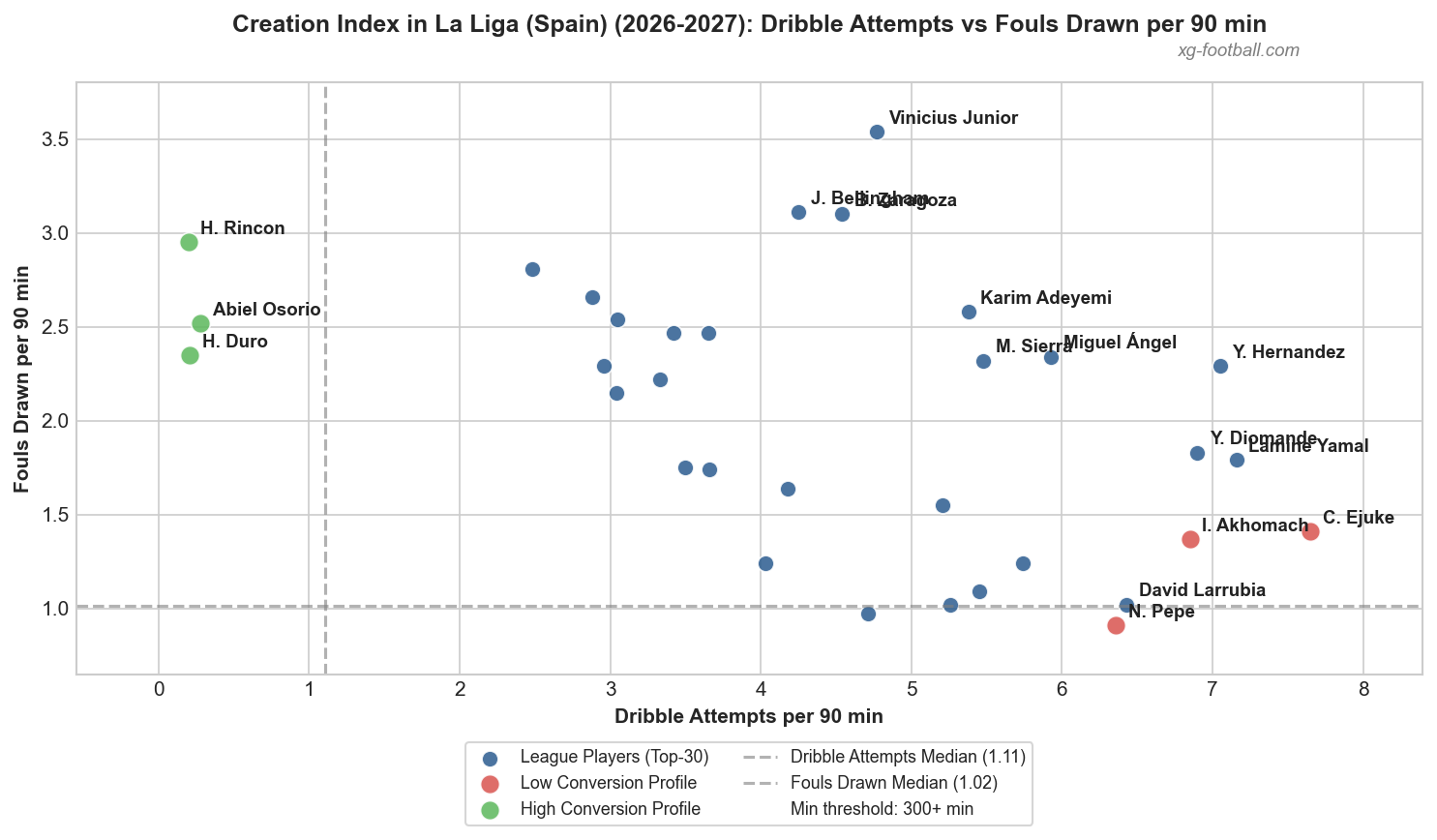
Individual creativity in modern football is about much more than goals and assists. The ability to beat opponents in one-on-one situations, carry the ball into dangerous areas and force defenders into committing fouls can be just as important in breaking down defensive structures. The 2026/27 La Liga statistics reveal a fascinating contrast between players who constantly look to take defenders on and those who know how to turn individual battles into valuable free kicks.
The study covers 306 players who have played at least 300 minutes. The league median stands at 1.11 dribble attempts per 90 minutes, while the median for fouls drawn is 1.02. These figures provide a useful benchmark for assessing individual attacking involvement across the Spanish top flight.
The numbers reveal that frequent dribbling is not necessarily the only route to attacking influence. Some players attempt to beat their opponents several times in almost every match, while others rely on close control, positioning and their ability to withstand physical pressure. The most interesting performers are those who combine both qualities, creating multiple problems for opposing defences.
Hernandez leads the overall ranking as Ejuke becomes La Liga’s most active dribbler
The biggest surprise at the top of the rankings is Y. Hernandez (Deportivo La Coruna). His combined figure of 9.34 is the highest among all 306 players in the study. Hernandez averages 7.05 dribble attempts and 2.29 fouls drawn per 90 minutes, comfortably exceeding both league medians.
His profile is particularly impressive because it combines two different attacking qualities. Hernandez does not simply attempt to beat defenders repeatedly; he also manages to draw a substantial number of fouls. His 511 minutes of playing time provide a reasonable sample for evaluating his contribution, although the relatively limited workload compared with some established stars remains worth considering.
Second place belongs to C. Ejuke (Sevilla), whose combined score reaches 9.06. Interestingly, Ejuke is actually the competition's leader in dribble attempts, averaging an extraordinary 7.65 per 90 minutes. His 1.41 fouls drawn indicate that his attacking influence comes primarily from direct individual challenges rather than winning free kicks.
That distinction makes Ejuke one of the most entertaining statistical profiles in the competition. He constantly looks to isolate defenders, accelerate past them and create advantages through individual skill. His 447 minutes are fewer than those accumulated by several other leading players, but his rate of activity is exceptional.
Lamine Yamal (Barcelona) completes the top three with a combined figure of 8.95. His 7.16 dribble attempts and 1.79 fouls drawn per 90 minutes confirm his importance as an individual attacking threat. Particularly significant is his playing time: 905 minutes, one of the highest totals among the leading performers.
Yamal's presence in this group is therefore supported by both outstanding per-90 statistics and a substantial volume of playing time. His ability to repeatedly challenge defenders gives Barcelona a direct attacking outlet, while the number of fouls he wins demonstrates how difficult opponents find it to contain him without resorting to contact.
Fourth place goes to Y. Diomande (Real Madrid), who records 6.90 dribble attempts and 1.83 fouls drawn per 90 minutes. His combined score of 8.73 places him firmly among the league's leading individual creators. Diomande's numbers are particularly interesting because they show that Real Madrid have another high-volume dribbler capable of taking responsibility in one-on-one situations.
His teammate Vinicius Junior (Real Madrid) occupies fifth position with a total of 8.31. Unlike Diomande, Vinicius relies less heavily on repeated dribbling attempts, recording 4.77 per 90 minutes. However, his 3.54 fouls drawn make him one of the most effective players in the competition at forcing defensive infringements.
This is an important distinction. Vinicius remains a highly active dribbler, but his ability to attract contact and win free kicks adds another dimension to his attacking influence. His numbers illustrate why defending against him can be such a difficult task: opponents must deal with both his direct running and his ability to exploit defensive pressure.
Sixth place belongs to Miguel Ángel (Sevilla), whose combined score of 8.27 comes from 5.93 dribble attempts and 2.34 fouls drawn per 90 minutes. His presence alongside Ejuke gives Sevilla two players in the top six, highlighting the club's impressive representation among the league's individual attacking threats.
I. Akhomach (Villarreal) follows in seventh position with 8.22. His 6.85 dribble attempts demonstrate a strong preference for direct attacking play, although his 1.37 fouls drawn are comparatively modest given his workload in one-on-one situations.
Eighth place is occupied by Karim Adeyemi (Barcelona), who records 5.38 dribble attempts and an impressive 2.58 fouls drawn per 90 minutes. His combined figure of 7.96 makes him another important contributor to Barcelona's attacking creativity. Alongside Yamal, he offers the Catalan side a different profile of individual threat, combining direct running with an ability to win free kicks.
M. Sierra (Sevilla) ranks ninth with 5.48 dribble attempts and 2.32 fouls drawn, reaching a total of 7.80. His figures further strengthen Sevilla's presence in the rankings, with three representatives among the leading twelve.
In tenth place, B. Zaragoza (Espanyol) produces a combined score of 7.64. His 4.54 dribble attempts are complemented by 3.10 fouls drawn per 90 minutes. Zaragoza therefore belongs to the group of players who combine direct attacking actions with a particularly strong ability to win defensive infringements.
The final two positions belong to David Larrubia (Malaga) and J. Bellingham (Real Madrid). Larrubia records 6.43 dribble attempts and 1.02 fouls drawn, producing a total of 7.45. His 882 minutes make his performance particularly notable, as he has maintained a high rate of individual activity over a substantial playing period.
Bellingham completes the top twelve with 7.36. His 4.25 dribble attempts and 3.11 fouls drawn per 90 minutes demonstrate a balanced attacking profile. The English midfielder is not simply relying on carrying the ball forward; he also regularly forces opponents into committing fouls, giving Real Madrid another player capable of generating advantages through individual actions.
The unlucky dribblers: Ejuke, Akhomach and Pepe work hard without winning enough fouls
The low-conversion category highlights players whose dribbling activity is exceptionally high compared with the number of fouls they draw. These footballers regularly attempt to beat defenders, but their individual challenges do not generate a proportional number of defensive infringements.
C. Ejuke (Sevilla) leads this group with 7.65 dribble attempts and 1.41 fouls drawn per 90 minutes. The difference reaches 6.24, the largest among the players identified in this category.
His statistics reveal an extremely direct attacking approach. Ejuke repeatedly tries to create advantages through individual skill, but relatively few of those situations end with opponents committing fouls. That does not make his dribbling ineffective in itself: beating a defender can create space, disrupt defensive positioning and open passing lanes even when no free kick is awarded.
I. Akhomach (Villarreal) occupies second place with 6.85 dribble attempts and 1.37 fouls drawn. His difference of 5.48 demonstrates a similar imbalance between individual attacking activity and the number of free kicks generated.
The third representative is N. Pepe (Villarreal). His 6.36 dribble attempts are accompanied by just 0.91 fouls drawn, producing a difference of 5.45. The presence of both Akhomach and Pepe in this category is particularly interesting for Villarreal. Both players appear comfortable taking defenders on, but neither generates a particularly high number of fouls relative to the frequency of those attempts.
It is important, however, not to confuse a low number of fouls drawn with poor attacking output. The available figures do not include successful dribbles, chances created, expected assists or the quality of teammates' finishing. Consequently, they cannot establish that these players are suffering because of poor finishing from their teammates.
A more accurate interpretation is that Ejuke, Akhomach and Pepe represent a high-volume dribbling profile in which individual challenges are not regularly converted into free kicks. Their wider contribution to attacking play may be considerably greater than these two indicators alone suggest.
The efficient operators: Rincon, Abiel Osorio and Duro turn minimal dribbling into free kicks
At the opposite end of the spectrum are players who rarely attempt to beat opponents through dribbling but still manage to draw a significant number of fouls. Their statistics demonstrate that attacking influence can be generated through positioning, physical presence and intelligent use of contact.
H. Rincon (Athletic Club) leads this category with an especially unusual statistical profile. He averages just 0.20 dribble attempts per 90 minutes, yet draws an impressive 2.95 fouls. The difference between the two indicators is -2.75, the strongest result in the high-conversion group.
Rincon's figures suggest that repeated dribbling is not central to his individual attacking contribution. Instead, he appears to generate value through situations in which opponents are forced to commit fouls despite his limited use of one-on-one dribbling.
Abiel Osorio (Elche) occupies second position. His 0.28 dribble attempts are accompanied by 2.52 fouls drawn per 90 minutes, producing a difference of -2.24. This is another example of a player who can generate defensive infringements without frequently attempting to beat opponents directly.
Third place belongs to H. Duro (Valencia), who records just 0.21 dribble attempts but draws 2.35 fouls per 90 minutes. His difference of -2.14 completes the category.
These profiles highlight an important tactical distinction. Winning fouls does not necessarily require taking defenders on in open space. A player can also use his body to protect possession, position himself intelligently between the ball and an opponent, or exploit pressure in contested situations.
Nevertheless, the term efficiency should be understood strictly within the framework of these two statistics. A high fouls-drawn figure relative to dribble attempts does not automatically indicate superior overall performance, successful finishing or greater creative output.
Real Madrid, Barcelona and Sevilla: three clubs with multiple attacking leaders
The distribution of players in the top twelve also reveals several interesting club-level patterns. Real Madrid have three representatives: Diomande, Vinicius Junior and Bellingham. Their profiles offer different ways of creating attacking advantages. Diomande focuses heavily on dribbling, Vinicius combines direct running with an outstanding ability to win fouls, while Bellingham offers a more balanced contribution from midfield.
Barcelona are represented by Lamine Yamal and Karim Adeyemi. Both players exceed the league median comfortably in dribble attempts and fouls drawn. Their presence gives Barcelona two different individual attacking options, with Yamal standing out for his dribbling volume and Adeyemi for his stronger fouls-drawn figure.
Sevilla are arguably the most interesting club in the rankings. Ejuke, Miguel Ángel and Sierra all feature in the top ten, with Ejuke leading the entire competition in dribble attempts. Their combined presence suggests a particularly strong concentration of individual attacking activity among Sevilla's leading performers.
Villarreal also deserve attention, although for a different reason. Akhomach and Pepe both appear in the low-conversion category. Their numbers reveal two players who frequently attempt to beat opponents but draw relatively few fouls compared with their dribbling volume.
Conclusion: Hernandez leads the overall ranking, Ejuke rules the dribbling charts and Vinicius dominates the art of winning fouls
The 2026/27 La Liga rankings reveal several distinct approaches to individual creativity. Y. Hernandez (Deportivo La Coruna) tops the combined ranking with 9.34, demonstrating an excellent balance between dribbling activity and fouls drawn.
C. Ejuke (Sevilla) is the competition's most active dribbler, averaging 7.65 attempts per 90 minutes, while Lamine Yamal (Barcelona) combines similarly impressive activity with a substantial playing-time sample. Y. Diomande (Real Madrid) further strengthens the group of high-volume individual attackers.
However, Vinicius Junior deserves special recognition for his ability to win fouls. His 3.54 fouls drawn per 90 minutes place him among the most effective players in this particular category. J. Bellingham, Karim Adeyemi and B. Zaragoza also demonstrate how important winning defensive infringements can be as part of an attacking player's overall contribution.
At the opposite end, H. Rincon (Athletic Club) provides one of the most unusual profiles in the study, drawing almost three fouls per 90 minutes despite attempting very few dribbles. Abiel Osorio and H. Duro demonstrate a similar ability to generate free kicks through approaches that do not depend on frequent one-on-one challenges.
The central conclusion is clear: creativity in modern football has multiple dimensions. Some players rely on acceleration, technique and repeated dribbling attempts, while others use positioning, physical presence and intelligent movement to force opponents into committing fouls. The most valuable attacking profiles are not necessarily identical — they are the ones that give their teams different ways to disrupt defensive structures and create opportunities.
Hernandez leads the overall statistical race, Ejuke is the undisputed leader in dribble volume, and Vinicius Junior demonstrates the enormous value of winning fouls. Together, they illustrate the diversity of individual attacking talent in La Liga.