
Who Are Europe's Most Creative Dribblers? Doku Leads the Attacking Rankings in 2026/27
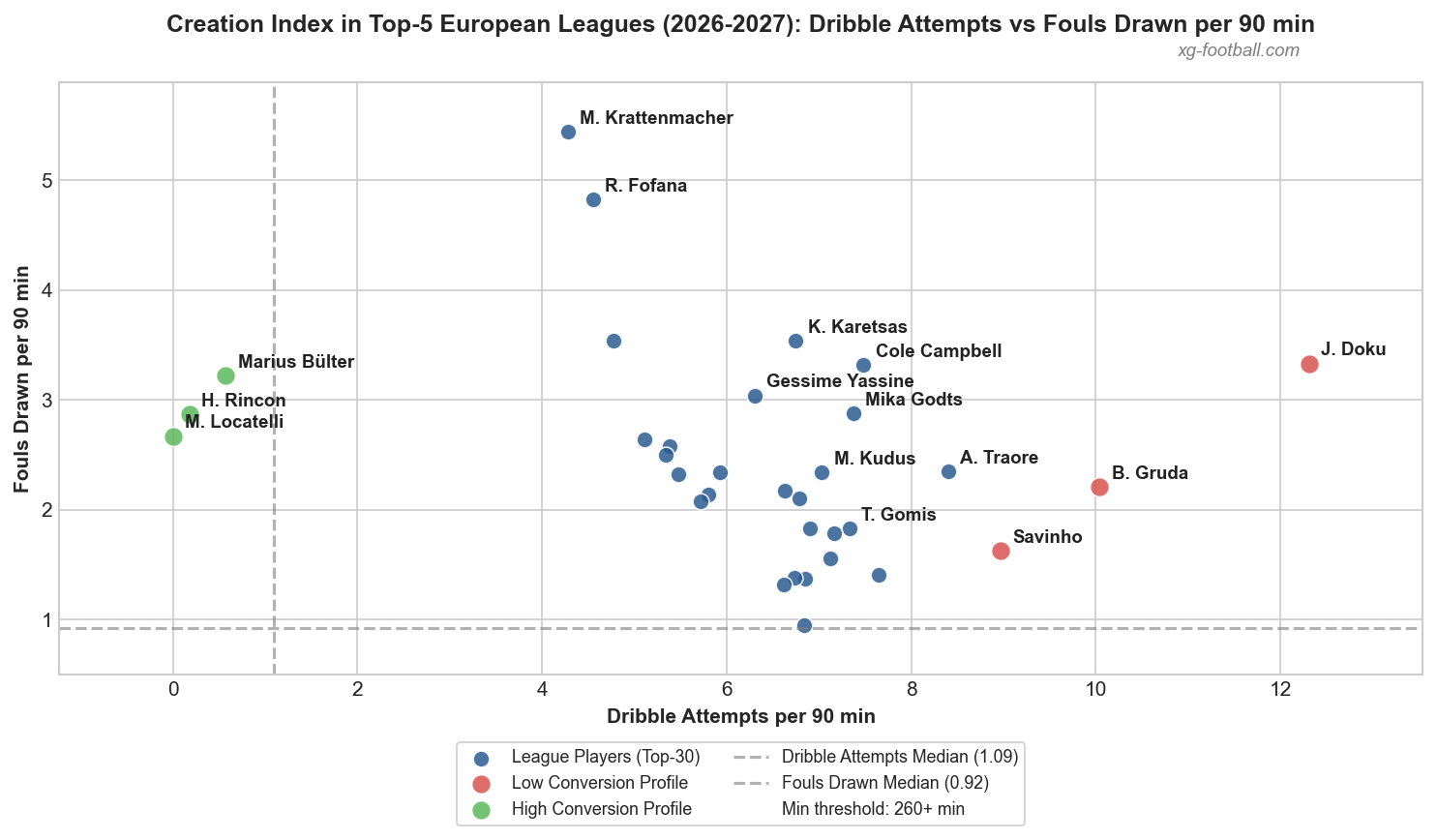
Individual creativity is one of the defining qualities of modern attacking football. The ability to beat opponents in one-on-one situations, carry the ball into dangerous areas and force defenders into committing fouls can transform the rhythm of a match. Statistics from the 2026/27 season across Europe's top five leagues reveal which players are taking the greatest individual responsibility and consistently putting opposing defences under pressure.
The analysis covers 1,379 players who have accumulated at least 260 minutes of playing time. The median number of dribble attempts stands at 1.09, while the median for fouls drawn is 0.92. These figures provide a useful benchmark for understanding the typical level of individual attacking activity across the competition.
The gap between these median values and the numbers produced by the leading performers is remarkable. Several attackers record dribbling figures many times higher than the tournament benchmark. This highlights their willingness to take defenders on, carry possession forward and create attacking opportunities through individual initiative. However, high dribbling volume and the ability to win fouls represent different aspects of creativity and should not automatically be interpreted as evidence of goalscoring or assisting efficiency.
Jeremy Doku Sets the Standard for Individual Creativity
Jeremy Doku of Manchester City leads the rankings with an impressive combined figure of 15.64, built on 12.31 dribble attempts and 3.33 fouls drawn. His dribbling statistic is particularly extraordinary, placing him comfortably ahead of every other player in the dataset.
Doku's numbers demonstrate how frequently he attempts to destabilise opposing defensive structures through direct attacking actions. His ability to challenge defenders individually makes him an important outlet in possession. The additional fouls he wins indicate that opponents also struggle to contain his movement without resorting to illegal challenges. With 351 minutes played, his figures are already exceptional, although a larger sample will be needed to assess whether he can maintain this pace throughout the season.
Brajan Gruda of RB Leipzig occupies second place with a combined score of 12.25. His 10.04 dribble attempts and 2.21 fouls drawn confirm that he is another player who regularly takes responsibility in attacking situations. Gruda's profile is built primarily around direct dribbling rather than winning fouls, making his approach somewhat different from that of some other players in the top rankings.
Third place belongs to Cole Campbell of SV Elversberg, who records a combined figure of 10.80. His 7.48 dribble attempts are complemented by 3.32 fouls drawn. The latter statistic is particularly impressive, placing him almost level with Doku in this category. Campbell therefore combines individual attacking initiative with a notable ability to force opponents into committing fouls.
A. Traore of Deportivo La Coruna follows closely in fourth place with 10.75. His statistics include 8.40 dribble attempts and 2.35 fouls drawn. Having played just 268 minutes, he has already produced one of the strongest attacking profiles in the dataset. His limited playing time is an important consideration, but his current numbers clearly identify him as a player worth monitoring.
Savinho of Tottenham completes the top five with 10.60. His 8.97 dribble attempts underline his preference for taking on defenders and creating situations through individual skill. However, his 1.63 fouls drawn are comparatively modest among the leading players, suggesting that his statistical contribution is driven more heavily by dribbling volume.
More Than Dribbling: Players Who Excel at Winning Fouls
The next group of performers highlights the importance of looking beyond dribbling attempts alone. K. Karetsas of Borussia Dortmund records 6.75 dribble attempts and 3.54 fouls drawn, producing a combined figure of 10.29. His fouls-drawn statistic is higher than those of Doku, Gruda and Savinho, illustrating that his attacking influence is not limited to taking on opponents.
Mika Godts of Paris Saint-Germain also makes the top group with 7.37 dribble attempts and 2.88 fouls drawn. His combined score of 10.25 places him seventh. The balance between these two figures suggests a player who contributes through both direct dribbling and the ability to attract defensive challenges.
One of the most intriguing profiles belongs to M. Krattenmacher of SV Elversberg. His 4.28 dribble attempts are considerably lower than those of the leading dribblers, but his 5.44 fouls drawn represent the highest figure in the entire top 12. His combined score of 9.72 demonstrates that a player does not need to dominate the dribbling rankings to have a major individual impact on opposition defenders.
M. Kudus of Tottenham contributes 7.03 dribble attempts and 2.34 fouls drawn, reaching 9.37 overall. His 538 minutes of playing time provide a larger sample than several other players near the top, making his current statistical profile particularly interesting.
R. Fofana of Le Havre matches Kudus's combined score of 9.37, but achieves it through a different balance: 4.55 dribble attempts and 4.82 fouls drawn. His ability to win fouls is particularly notable and places him among the strongest performers in that category.
Gessime Yassine of Strasbourg records 6.30 dribble attempts and 3.04 fouls drawn, producing a total of 9.34. With 829 minutes played, he has accumulated considerably more playing time than many players in the leading group. That makes his position especially noteworthy because his numbers have been maintained across a relatively larger sample.
The top 12 is completed by T. Gomis of RB Leipzig, who registers 7.33 dribble attempts and 1.83 fouls drawn. His combined figure of 9.16 confirms his place among the most active individual attackers in the dataset.
The Unlucky Group: High Activity Without a Matching Return
The low-conversion profile identifies three players whose dribbling activity is not matched by an equally strong figure in the accompanying attacking metric. Jeremy Doku of Manchester City leads this group with a reported difference of 8.98. Brajan Gruda of RB Leipzig follows with 7.83, while Savinho of Tottenham records 7.34.
These figures highlight a considerable imbalance between dribbling attempts and fouls drawn. Doku, Gruda and Savinho all attempt to beat defenders frequently, but their dribbling totals exceed their fouls-drawn figures by a substantial margin.
It would be premature, however, to describe these players as genuinely unlucky or to conclude that their teammates are failing to convert the opportunities they create. The supplied statistics do not include successful dribbles, chances created, expected assists or missed opportunities. Consequently, they cannot establish whether individual actions resulted in clear scoring opportunities or whether teammates failed to take advantage of them.
What the numbers do confirm is that these three footballers rely heavily on individual ball-carrying and dribbling. Their next challenge is to translate that activity into more tangible attacking contributions, whether through successful final passes, dangerous deliveries or direct involvement in goalscoring situations.
Efficiency Specialists: Less Dribbling, More Fouls Won
At the opposite end of the spectrum, several players demonstrate a different form of attacking influence. Their dribbling figures are relatively low, but their ability to win fouls is considerably stronger. This profile suggests that individual creativity can take forms other than repeatedly attempting to beat opponents in one-on-one situations.
H. Rincon of Athletic Club records just 0.18 dribble attempts but wins 2.87 fouls. His profile is particularly distinctive because his fouls-drawn figure is substantially higher than his dribbling activity.
M. Locatelli of Juventus provides another example. He records zero dribble attempts alongside 2.67 fouls drawn. This demonstrates that winning fouls does not necessarily depend on frequent dribbling. Positioning, ball protection and the ability to draw contact from opponents can also contribute to this statistic.
Marius Bülter of 1. FC Köln completes the group with 0.57 dribble attempts and 3.22 fouls drawn. His ability to win fouls despite relatively limited dribbling activity makes him an interesting example of a different attacking profile.
These players can be described as efficient in terms of their relationship between dribbling attempts and fouls drawn. Nevertheless, the available figures do not establish that they are more efficient in terms of overall attacking output, since goals, assists, successful dribbles and chances created are not included.
What the Statistics Tell Us About Attacking Creativity
The 2026/27 data reveal several distinct approaches to individual attacking influence across Europe's top five leagues. Jeremy Doku stands out as the most active dribbler, while M. Krattenmacher leads the top 12 in fouls drawn. Cole Campbell combines both qualities particularly effectively, and R. Fofana demonstrates how a high fouls-drawn figure can compensate for a comparatively modest number of dribble attempts.
The contrast between the league medians and the leading performers also illustrates how concentrated individual creativity can be. While the typical player records 1.09 dribble attempts and 0.92 fouls drawn, the leading attackers operate at a dramatically higher level of activity.
The most important conclusion is that there is no single formula for influencing attacking play. Some players constantly challenge defenders with the ball, others create pressure through movement and physical duels, while some combine both approaches. As the season progresses and the sample sizes increase, it will become easier to determine which of these profiles translates into the greatest contribution to actual goalscoring opportunities and team success.