
B. Gruda Leads the Bundesliga’s Duel Rankings: Who Dominates the Physical Battles and Who Relies on Fouls?
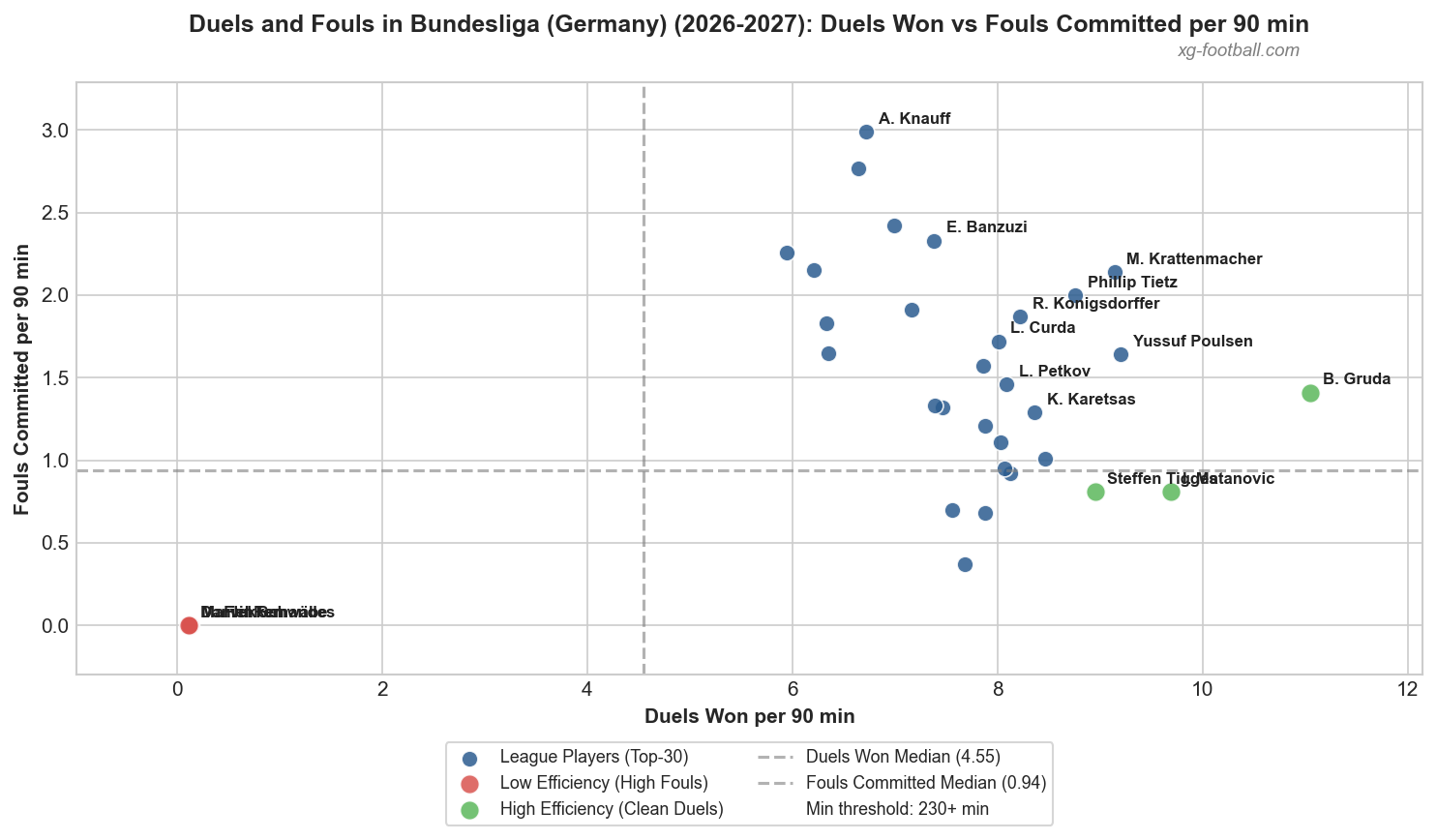
Winning individual battles is one of the defining characteristics of competitive football. While goals and assists often attract the headlines, the ability to win duels, protect possession and disrupt opposition attacks can be just as important in determining a team's success. The Bundesliga's 2026/27 statistics reveal which players are setting the standard in physical contests and which combine their aggressive approach with a relatively high number of fouls.
The analysis covers 258 players who have played at least 230 minutes. The league median stands at 4.55 duels won and 0.94 fouls committed. These figures provide a useful benchmark for evaluating individual performances. Players significantly above the median for duels won demonstrate an unusually high level of involvement and success in physical contests.
However, winning duels is only part of the picture. The number of fouls committed adds another dimension to the analysis, helping distinguish players who combine physical effectiveness with discipline from those whose aggressive approach frequently results in infringements.
B. Gruda Sets the Standard for Winning Duels
The standout performer is B. Gruda of RB Leipzig, who leads the rankings with 11.05 duels won and 1.41 fouls committed. His combined figure of 12.46 is the highest among all 12 players featured in the dataset.
Gruda's advantage becomes even clearer when compared with the league median. His duels-won figure is more than twice the typical benchmark of 4.55, highlighting just how frequently he emerges victorious from individual contests. His foul count is also above the league median, but the difference is relatively modest considering his exceptional volume of successful duels.
In second place is M. Krattenmacher of SV Elversberg, with 9.14 duels won and 2.14 fouls committed. His combined figure reaches 11.28. Although he trails Gruda in successful duels, his higher foul count contributes to a stronger combined total than several players who actually win more individual battles.
Yussuf Poulsen of Hamburger SV occupies third position with 9.20 duels won and 1.64 fouls. His combined figure of 10.84 places him narrowly ahead of the next player in the rankings. Interestingly, Poulsen wins slightly more duels than Krattenmacher while committing fewer fouls, illustrating the importance of examining individual components rather than relying exclusively on the combined ranking.
Fourth place belongs to Phillip Tietz of FSV Mainz 05. He has recorded 8.76 duels won and 2.00 fouls committed, producing a combined figure of 10.76. His playing time of 719 minutes is particularly noteworthy, providing a larger sample than several players above him.
Completing the top five is I. Matanovic of SC Freiburg, whose numbers make him one of the most interesting players in the entire analysis. He has won 9.69 duels while committing just 0.81 fouls. His combined figure stands at 10.50. Although he ranks fifth in the overall combined standings, his duel-winning performance is second only to Gruda's.
The Other Standouts in the Top 12
R. Konigsdorffer of FSV Mainz 05 occupies sixth place with 8.22 duels won and 1.87 fouls. His combined figure is 10.09. Having played just 241 minutes, he has produced an impressive statistical return, although his relatively limited playing time means that further appearances will be important in establishing whether this level can be maintained.
Another particularly impressive performer is Steffen Tigges of SC Paderborn 07. He has registered 8.95 duels won and only 0.81 fouls, giving him a combined figure of 9.76. His numbers place him among the strongest examples of efficient physical play in the dataset.
L. Curda, also representing SC Paderborn 07, follows closely with 8.01 duels won and 1.72 fouls. His 787 minutes make him one of the most extensively involved players in the top 12. His presence alongside Tigges gives Paderborn two representatives among the leading duel winners.
E. Banzuzi of RB Leipzig has recorded 7.38 duels won and 2.33 fouls, producing a combined figure of 9.71. His numbers suggest an aggressive approach to individual battles, although his foul count is considerably higher than those of the most disciplined players in the ranking.
A. Knauff of Eintracht Frankfurt shares the same combined figure of 9.71, but arrives at it through a different statistical profile. His 6.72 duels won are accompanied by 2.99 fouls committed, the highest foul figure among the top 12. This makes him a particularly interesting case when examining the relationship between physical involvement and discipline.
The final two positions belong to K. Karetsas of Borussia Dortmund and L. Petkov of SV Elversberg. Karetsas has registered 8.36 duels won and 1.29 fouls, while Petkov has recorded 8.09 duels won and 1.46 fouls. Their combined figures stand at 9.65 and 9.55 respectively. Both comfortably exceed the league median for successful duels.
Efficiency: Gruda, Matanovic and Tigges Lead the Way
Looking beyond the combined ranking reveals another important dimension. By calculating the difference between duels won and fouls committed, it is possible to identify players who combine a high volume of successful contests with relatively few infringements.
B. Gruda again leads the way, recording a positive balance of 9.64. His 11.05 duels won against 1.41 fouls underline his ability to dominate individual battles without relying excessively on illegal challenges.
I. Matanovic ranks second with a balance of 8.88. His combination of 9.69 successful duels and just 0.81 fouls is particularly impressive. He is one of the clearest examples of a player who can impose himself physically while maintaining a relatively disciplined approach.
Steffen Tigges completes the top three with a balance of 8.14. His 8.95 duels won and 0.81 fouls give him an almost identical disciplinary profile to Matanovic, although his number of successful duels is slightly lower.
It is important to clarify that this balance is an analytical comparison rather than an official football efficiency metric. It does not account for unsuccessful duels, the total number of challenges attempted or the tactical context behind individual fouls. Nevertheless, it provides a useful way to identify players whose statistical profiles combine high duel-winning output with relatively few infringements.
The Statistical Anomalies: Extremely Low Duel and Foul Figures
The lower end of the supplied dataset features Daniel Fernandes of Hamburger SV, M. Flekken of Bayer Leverkusen and Marvin Schwäbe of 1. FC Köln.
Fernandes has recorded just 0.11 duels won, while Flekken and Schwäbe have each registered 0.12. All three have a foul figure of 0.00.
These numbers require careful interpretation. The players are not committing excessive fouls; in fact, the supplied statistics show no fouls at all. Their low balances are driven by the extremely small number of recorded successful duels.
Their positions are also important when interpreting the data. Goalkeepers naturally participate in different types of physical contests compared with outfield players. Consequently, comparing their duel-winning figures directly with those of midfielders, forwards or defenders can produce misleading conclusions.
Without information about unsuccessful duels, total challenges and positional responsibilities, it would be inappropriate to interpret these figures as evidence of poor overall performance. They simply highlight how different player roles can influence statistical rankings.
Who Commits the Most Fouls Among the Leading Duel Winners?
Among the top 12, A. Knauff of Eintracht Frankfurt records the highest foul figure at 2.99. He is followed by E. Banzuzi of RB Leipzig with 2.33 and M. Krattenmacher of SV Elversberg with 2.14.
All three are considerably above the league median of 0.94 fouls. Their statistics suggest a more aggressive profile than that of players such as Matanovic and Tigges, who combine high duel-winning numbers with just 0.81 fouls each.
However, committing more fouls does not automatically indicate poor defensive ability or a lack of discipline. Some infringements are tactical, allowing teams to stop dangerous counterattacks or recover their defensive shape. Understanding whether these fouls are necessary or avoidable would require examining individual match situations.
Final Verdict: Gruda Leads, but Matanovic and Tigges Offer a Different Kind of Excellence
The Bundesliga's 2026/27 statistics reveal several distinct profiles among the league's leading duel winners. B. Gruda of RB Leipzig is the standout performer, leading the combined ranking and the efficiency comparison while recording an extraordinary 11.05 duels won.
I. Matanovic of SC Freiburg and Steffen Tigges of SC Paderborn 07 deserve special recognition for their ability to combine high duel-winning figures with just 0.81 fouls. Their performances demonstrate that physical dominance does not necessarily require an excessive number of infringements.
Meanwhile, players such as A. Knauff, E. Banzuzi and M. Krattenmacher represent a more aggressive statistical profile, with considerably higher foul figures accompanying their involvement in individual battles.
The central takeaway is that successful physical play is about more than simply winning challenges. It is also about how those victories are achieved and how much discipline is maintained in the process. For now, Gruda sets the benchmark, while Matanovic and Tigges provide compelling examples of how intensity and discipline can work together.