
Messias Leads the Duel Battle in Serie A: Who Are Italy’s Most Combative Players?
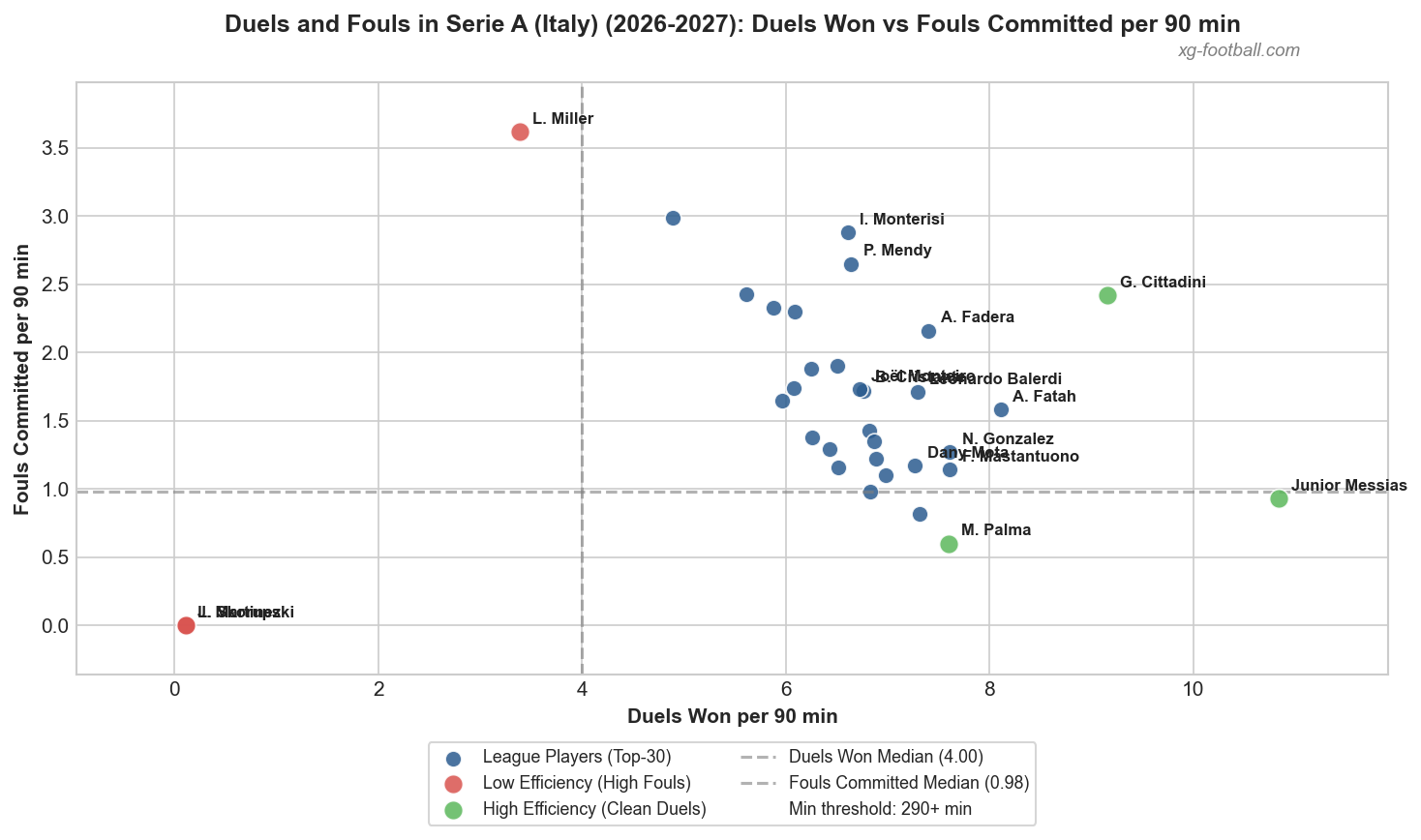
Duels remain a crucial part of Serie A football in the 2026–27 season, but the numbers reveal significant differences in how players approach physical contests. Among the 296 players who have played at least 290 minutes, the league median stands at 4.0 duels won and 0.98 fouls committed. These figures provide a useful benchmark for identifying players who consistently win individual battles and those whose involvement comes with a higher risk of conceding fouls.
The relationship between the two metrics is particularly revealing. A high number of duels won indicates an ability to compete effectively for possession, while the foul count offers some insight into the cost of that aggression. Neither statistic tells the whole story, however: a player's position, responsibilities and role within the team all influence how often they enter challenges and how those contests unfold.
The Leaders: Junior Messias Sets the Pace
Junior Messias of Genoa is the standout performer in the dataset. He averages an exceptional 10.84 duels won, almost 2.7 times the league median, while committing just 0.93 fouls. His foul rate is slightly below the competition benchmark, making his combination of volume and discipline particularly impressive. Across 581 minutes, Messias has established himself as the leading figure in this statistical category.
G. Cittadini of Frosinone ranks second in the combined total of duels won and fouls committed, recording 9.16 duels won and 2.42 fouls per match. His combined figure of 11.58 is close to Messias' 11.77, but the underlying profiles are quite different. Cittadini wins fewer duels and commits considerably more fouls, suggesting a more costly approach to physical contests.
Third place belongs to A. Fatah of Lecce, who averages 8.11 duels won and 1.58 fouls. His duel-winning rate is more than double the league median, although his foul count is also above the competition benchmark.
A. Fadera of Cagliari follows with 7.40 duels won and 2.16 fouls. His combined figure of 9.56 is among the highest in the group, but his 292 minutes are only just above the eligibility threshold. That relatively small sample should be considered when assessing the sustainability of his numbers.
I. Monterisi, another Frosinone player, averages 6.61 duels won and 2.88 fouls across 626 minutes. His involvement in physical contests is substantial, but his foul rate is almost three times the league median. P. Mendy of Cagliari has a similar profile, recording 6.64 duels won and 2.65 fouls in 746 minutes.
Leonardo Balerdi of AS Roma stands out with 7.29 duels won and 1.71 fouls in 420 minutes. Meanwhile, N. Gonzalez of Juventus and F. Mastantuono of Fiorentina both average 7.61 duels won. Gonzalez commits 1.27 fouls, compared with Mastantuono's 1.14, giving the Fiorentina player a slightly cleaner statistical profile.
B. Cristante of AS Roma records 6.76 duels won and 1.72 fouls across 786 minutes, while Joël Monteiro of Lecce posts 6.72 and 1.73 respectively. Completing the top 12 is Dany Mota of Monza, with 7.27 duels won and just 1.17 fouls in 384 minutes. His figures suggest an effective balance between involvement and restraint.
Statistical Anomalies: Efficiency, Discipline and Excessive Fouling
The high-efficiency group reinforces the impression that winning duels does not necessarily require committing large numbers of fouls. Junior Messias leads this ranking with a balance of +9.91, calculated by subtracting fouls committed from duels won. His 10.84 successful duels against 0.93 fouls make him the clearest example of high-volume, relatively disciplined involvement.
M. Palma of Udinese takes second place with 7.60 duels won and only 0.60 fouls, producing a balance of +7.00. His foul rate is well below the league median, while his duel-winning figure is almost twice the benchmark. That combination makes Palma one of the most striking performers in the efficiency category.
G. Cittadini completes the top three with a balance of +6.74. Although his 2.42 fouls are considerably above the league median, his 9.16 successful duels are high enough to keep him among the leading players by this measure. His case illustrates why the balance should be considered alongside the individual figures rather than in isolation.
At the other end of the scale, L. Miller of Udinese is the clearest negative outlier. He averages 3.39 duels won against 3.62 fouls, resulting in a balance of approximately -0.23. His duel-winning figure is below the league median, while his foul count is more than three and a half times the benchmark. Among the players highlighted, this is the strongest example of a high foul rate combined with a relatively modest return in successful duels.
L. Skorupski of Bologna and J. Martinez of Inter both record just 0.11 duels won and zero fouls, giving each a balance of +0.11. These figures should not be interpreted as evidence of exceptional duel efficiency. Their extremely low duel involvement means there is little activity in either category to evaluate, and their numbers are not directly comparable with those of players who regularly contest possession.
There is an important distinction in how these rankings are constructed. The combined figure of duels won plus fouls committed measures the volume of activity across two separate statistics; it is not an official performance or efficiency metric. Likewise, the balance of duels won minus fouls is a simple comparative indicator, not a comprehensive measure of defensive contribution or discipline. Used together with the underlying numbers, however, both calculations help highlight different styles of involvement.
Conclusion: Winning the Battle Without Paying the Price
The Serie A data point to a clear standout: Junior Messias combines the highest duel-winning rate among the listed players with a foul count below the league median. M. Palma offers another compelling example of efficiency, while G. Cittadini demonstrates how a high volume of successful challenges can coexist with a much larger number of fouls.
For teams looking to gain an advantage in physical contests, the message is straightforward: winning duels matters, but how that advantage is achieved matters too. The most valuable profiles are not necessarily those who enter the most challenges, but those who consistently come out on top without repeatedly giving away free kicks.