
Ligue 1 2026–27: Dembélé Leads the Creative Charge as Picard Waits for His Teammates to Deliver
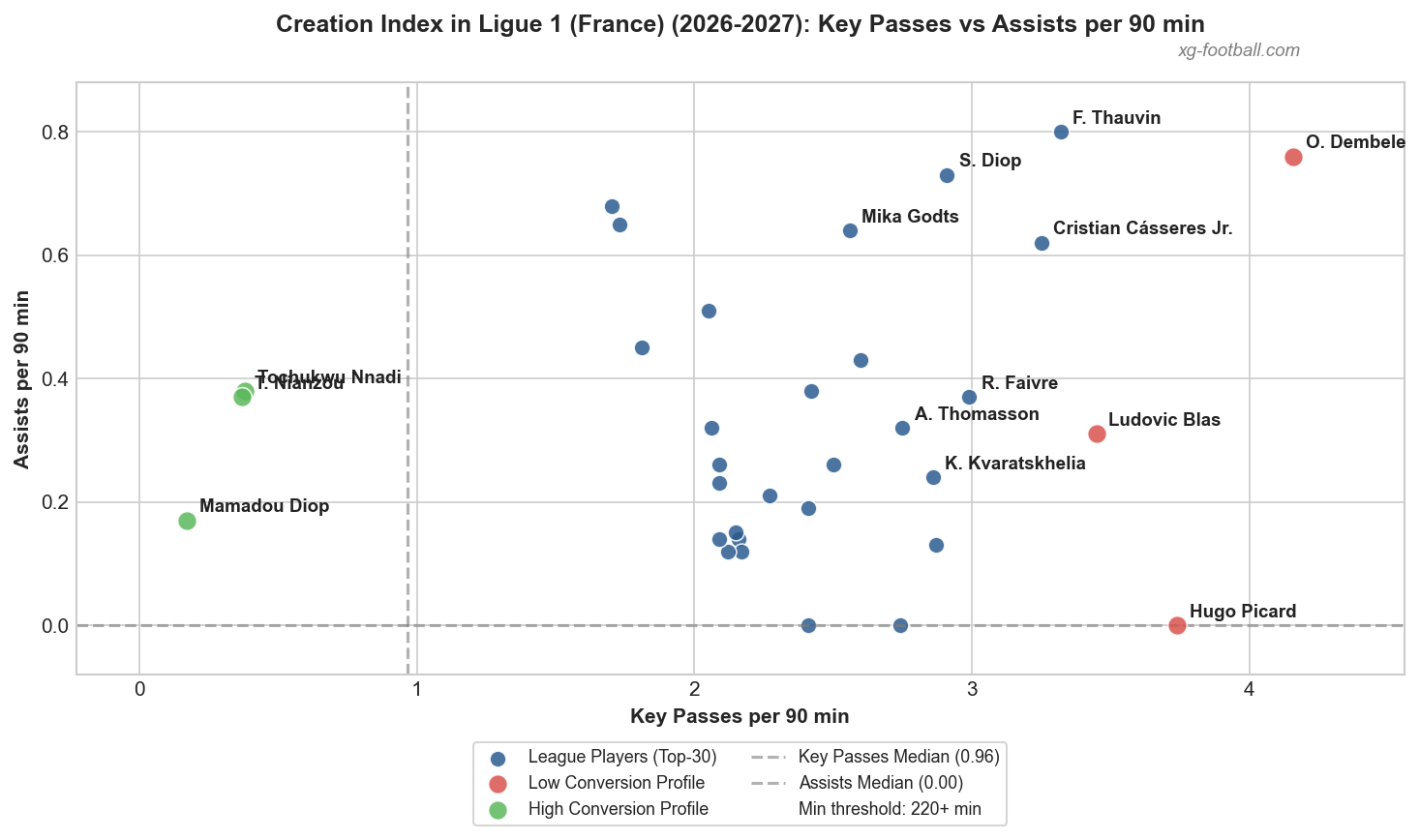
The early creative rankings in Ligue 1 reveal a fascinating contrast between attacking influence and tangible end product. Some players are consistently creating opportunities, others are already converting their involvement into assists, and a few are producing impressive numbers without seeing the same reward on the scoresheet.
The dataset covers 230 players who have played at least 220 minutes. The league median stands at 0.96 key passes and 0.0 assists. That provides a useful baseline: the typical player in the sample creates around one shot-producing opportunity per match-equivalent, while at least half the players have yet to register an assist at the measured rate.
Against that backdrop, the leading creators stand out dramatically. Several are producing more than three key passes per game-equivalent, putting them well above the league median. Yet the figures also highlight an important distinction: creating a shooting opportunity and creating a goal are two different achievements.
The leaders: Dembélé sets the pace
Ousmane Dembélé — Paris Saint-Germain
Ousmane Dembélé tops the creative rankings with 4.16 key passes and 0.76 assists, giving him a combined score of 4.92 in the supplied metric. His key-pass figure is more than four times the league median, making him the most prolific chance creator in this sample.
The striking detail is his playing time: Dembélé has accumulated only 238 minutes. That makes his numbers explosive, but also means they should be treated as an early snapshot rather than proof of a sustainable season-long rate. A few appearances can dramatically influence per-match statistics.
Even so, the underlying message is clear. Dembélé is heavily involved in the final stages of PSG attacks, repeatedly supplying teammates with opportunities to shoot. His challenge will be to maintain that creative intensity as his minutes increase and opponents adapt to his influence.
Florian Thauvin — Lens
Florian Thauvin occupies second place with 3.32 key passes and 0.80 assists across 787 minutes. His output combines a high volume of chance creation with the strongest assist figure among the top five.
Unlike Dembélé, Thauvin has already played a substantial number of minutes. That longer sample gives his performance a little more weight: he is not simply producing a spectacular rate in a brief cameo, but maintaining a significant creative contribution over a more extended run.
For Lens, Thauvin's value lies in the connection between preparation and execution. He creates opportunities regularly and has also seen a meaningful share of those attacking sequences end in goals. If the pattern continues, he could become one of the league's most dependable creative outlets.
Cristian Cásseres Jr. — Toulouse
Cristian Cásseres Jr. ranks third with 3.25 key passes and 0.62 assists in 720 minutes. His numbers place him firmly among the league's most active playmakers.
Cásseres may not command the same attention as the biggest names in the division, but his statistical profile suggests a player who repeatedly helps Toulouse move attacks into dangerous areas. His combination of key passes and assists points to involvement both before the shot and at the decisive moment.
The next question is consistency. Maintaining this level across a larger sample would strengthen the case that his current output reflects a lasting role in Toulouse's attacking structure rather than a temporary surge.
Ludovic Blas — Rennes
Ludovic Blas has recorded 3.45 key passes and 0.31 assists in 287 minutes. His creative volume is exceptional, but his assist return is more modest than those of Thauvin and Cásseres.
That difference places Blas in an intriguing category: a player whose contribution to the creation of chances is more obvious than his direct contribution to goals. The discrepancy does not automatically mean his teammates are wasting opportunities. Key passes can lead to difficult shots, and assists depend on the finishing action as well as the quality of the pass.
Still, Blas is creating enough to merit attention. If his teammates begin converting a greater share of the chances he helps generate, his assist tally could rise quickly.
Hugo Picard — ESTAC Troyes
Hugo Picard is one of the most striking names in the dataset. He has produced 3.74 key passes in 337 minutes, yet his assist figure remains at zero.
That is the clearest high-volume, low-return profile among the leading creators. Picard is regularly setting up shots, but none of those opportunities has translated into an assist in the supplied figures.
For Troyes, this could represent a hidden attacking asset. A player who consistently creates opportunities can influence matches even when the final statistical reward is missing. However, key-pass totals alone cannot tell us whether the chances were clear-cut or whether teammates should reasonably have scored from them. Expected assists (xA) and shot-quality data would help answer that question.
Picard is therefore a strong candidate for the label of an unlucky creator — but not yet definitive proof of poor finishing around him.
More creative threats across the league
The top ten also includes several players whose profiles illustrate different routes to attacking influence.
S. Diop of Nice has recorded 2.91 key passes and 0.73 assists in 371 minutes. His assist return is particularly notable relative to his creative volume, suggesting that a substantial share of his attacking involvement has already produced direct outcomes.
R. Faivre of Auxerre has accumulated 2.99 key passes and 0.37 assists in 482 minutes. His chance creation is comfortably above the league median, although the assist figure suggests a more modest direct return so far.
Mika Godts of Paris Saint-Germain has posted 2.56 key passes and 0.64 assists in 281 minutes. Like Dembélé, he has produced eye-catching numbers in a relatively short spell. If his involvement remains consistent over more playing time, he could emerge as another important creative option for PSG.
K. Kvaratskhelia, also of Paris Saint-Germain, has registered 2.86 key passes and 0.24 assists in 377 minutes. His presence reinforces the impression that PSG have several players capable of creating shooting opportunities rather than relying on a single source of invention.
A. Thomasson of Rennes rounds out the top ten with 2.75 key passes and 0.32 assists in 557 minutes. His figures suggest a steady creative contribution, even if he has not matched the combined output of the leading names.
Together, these players demonstrate that attacking creativity is distributed across several teams. PSG have multiple contributors near the top, while Lens, Toulouse, Nice, Auxerre, Rennes and Troyes all feature players with noteworthy creative profiles.
The unlucky creators: when the final pass goes unrewarded
The low-conversion group highlights three players: Hugo Picard of ESTAC Troyes, Ousmane Dembélé of Paris Saint-Germain and Ludovic Blas of Rennes.
Picard is the most obvious case because his 3.74 key passes are accompanied by zero assists. His figures suggest a considerable gap between creating opportunities and receiving credit for goals.
Blas has a similarly interesting profile. With 3.45 key passes and 0.31 assists, he is generating chances at a high rate but has yet to see a matching level of direct return. His short sample of 287 minutes adds uncertainty, but his creative activity is difficult to overlook.
Dembélé's inclusion requires more nuance. He has 0.76 assists alongside 4.16 key passes, so he is not producing nothing in return. His appearance in the low-conversion category seems to reflect a gap between his exceptionally high creative volume and the expected combined output, rather than an absence of assists.
There is also a data-quality caveat: the low-conversion block lists Dembélé's combined figure as 3.40, despite the main ranking reporting 4.16 key passes and 0.76 assists. Those two values sum to 4.92, not 3.40. The category may use a different calculation, but the methodology is not supplied, so the discrepancy should not be silently treated as a confirmed measure of conversion.
The broader lesson is that key passes and assists measure different parts of an attacking sequence. A player can create repeatedly without accumulating assists, but confirming genuine bad luck requires more detailed evidence about the chances created and the shots taken.
The efficient profiles: low volume, visible return
The high-conversion group features Tochukwu Nnadi of Marseille, T. Nianzou of Lille and Mamadou Diop of Auxerre.
Nnadi has recorded 0.38 key passes and 0.38 assists, while Nianzou has 0.37 in each category. Mamadou Diop's figures stand at 0.17 key passes and 0.17 assists. Their creative volume is far below that of the headline playmakers, but their assist figures are notable in relation to their key-pass rates.
These profiles may indicate that the players are contributing to goals without serving as primary creators. They might be involved in a small number of decisive sequences, or their role may focus on other aspects of play before the final pass. The data provided cannot establish which explanation applies.
Nor does a low key-pass total automatically prove exceptional efficiency. To measure conversion rigorously, analysts would need a consistent definition of the metric, a larger sample, and ideally expected-assist data. A player with one or two decisive contributions can look extraordinarily efficient early in a season, only for the rate to change as more minutes accumulate.
The combined figures in this block are also listed as zero, despite the positive key-pass and assist values. As with the low-conversion group, that prevents a reliable comparison using the stated combined metric. The individual numbers remain useful, but the precise efficiency ranking should be treated cautiously.
One distinction is especially important: Mamadou Diop of Auxerre is not S. Diop of Nice. They are separate players at different clubs with different statistical profiles. The Nice player ranks among the leading creators, while the Auxerre player appears in the low-volume, high-conversion group.
The verdict: creativity is only half the story
Ligue 1's early creative rankings offer three main takeaways.
First, Dembélé is the standout chance creator in the sample, while Thauvin and Cásseres combine high output with a more substantial number of minutes. Their performances give us the clearest early evidence of sustained creative influence.
Second, Picard and Blas illustrate the gap between creating shots and collecting assists. Their figures warrant attention, although further data would be needed to establish whether the missing return is caused by poor finishing, low-quality chances or simple statistical variance.
Finally, Nnadi, Nianzou and Mamadou Diop offer intriguing low-volume profiles, but their apparent efficiency should not be confused with proven long-term superiority. Their numbers need a larger sample and a consistent conversion metric before firm conclusions can be drawn.
With a median of just 0.96 key passes and 0.0 assists, the leading creators are already operating well above the typical level in this dataset. The next test is whether they can sustain those rates — and whether their teammates can turn more of their work into goals.
Because in football, the final pass only tells part of the story. The quality of the chance, the finish that follows and the consistency of the performance determine whether a creator becomes a statistical leader or a genuinely decisive player.